The Cyclist’s Training Bible (3rd Edition) Review

Joe Friel has been involved in training and coaching highly successful athletes since the early 1980’s. He holds a master’s degree in Exercise Science and is a USA Triathlon and USA Cycling Certified Coach. He is also a columnist for a variety of well-known sporting magazines and writes his own blog at:

 www.joefrielsblog.com/  or www.trainingbible.com 

This is Friel’s third edition of this book along with others such as The Mountain Biker’s Training Bible, The Triathletes Training Bible etc.

The Cyclists Training Bible is Foreworded by Dr. Tudor O. Bompa who is considered the “father of periodization”. Periodization is what this third edition is all about.

The book has evolved over the last decade into this its third edition mainly due to the experiences of Friel and the many advances in science, research and technology. I have read the first two editions and can attest to the transitions due to advances. The “Ten Commandments”1. Train Moderately 2. Train Consistently 3. Get Adequate Rest 4. Train with a Plan 5. Train with Groups Infrequently 6. Plan to Peak 7. Improve Weakness 8. Trust your Training 9. Listen to Your Body 10. Commit to Your Goals  used by Friel are his thinking on the philosophy that should be held by an athlete regardless of age or sex  if that athlete wishes to be successful. He explains each individually at the start of this book

The book will take you from testing in the lab onto the road through peaking and recovering (Periodization). Each chapter is specifically written to enable and athlete to design and periodize a training program for themselves. The science of training is discussed with issues such as physiology and fitness, training stress, fatigue and the principles of training detailed. Part III discusses how to test, assess performance and how to apply test results. It also shows the athlete how to deal with abilities on the bike and how to adjust training both on and off the bike in order to strengthen limiters.

In Part IV Friel goes through  how a training plan is to be structured and developed for the athlete. Whether it is a single or double peak Friel details out how this can be achieved. The Annual Training Plan, ATP Workout Categories, Weekly Routines are just some of the items discussed. The book is full of charts and graphs explaining to the athlete what has to be done, such as a training diary, the full periodization chart, racing abilities chart and self-assessment chart for the rider to fill out.

The final Part and Chapters of the book deals with specific training and recovery. Short Term recovery, Long Term Recovery and how best to achieve this. Injuries and recovering from them, overtraining, its signs, burnout and most of the problems that a rider will encounter during the periodized process are discussed. Other chapters deal with Unique needs for the athlete such as Juniors, Ladies and the Masters. Stretching and Strength training is discussed along with Diet, Antioxidant Supplements  and Ergogenic Aids.

The book has a good glossary and index with informative examples.

This book provides a good basis for an athlete who is thinking of writing his/her own training programs to generate a structured program. If it was to be combined with “Training and Racing With a Power Meter” for those who use a power meter it would be a complete system as Friel book does not have sufficient detail on power metering.

Other examples of Friels work;


Posted in Reviews | Tagged , , , , , , , , , , , , , , , , , , , , , , , , , , , , , , | 1 Comment

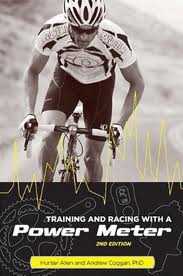
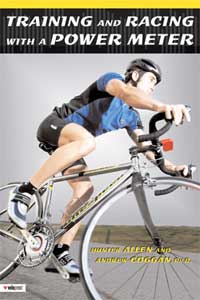
Training an Racing with a Power Meter (2nd Ed) Review

The Authors of this book are Hunter Allen and Andrew Coggan PhD. Hunter Allen is an elite cycling coach, former professional cyclist and owner of the Peaks Coaching Group. Andrew Coggan is an exercise physiologist and author of numerous articles related to the application of the power meter data.

http://www.trainingandracingwithapowermeter.com/

The aim of the book is to introduce the power meter, its data and its applications to the cyclist who can then structure and execute their training programs in a professional and effective manner. With the power meter now available to the masses and not just the professional cyclist it is  a matter of necessity that the universal concepts of its application be known to all. This is exactly what this book does. It explains the advantages and disadvantages in brief of most of the power meters on the market today. The book then explains in detail how the athlete should download, read and interoperate the information gathered on the meter after training.

Athlete power profiling is one of the first tasks that the book deals with. It shows how the athlete should execute a test and determine their power profile from that test and then how to interoperate this information for the application of exercise prescription,. It will also explains fatigue profiling and how to structure training in order to eliminate those flat spots and build power.

Once testing has been completed a detailed example of how to structure a training plan for a particular season and athlete  is detailed. This is done for two individuals, one male masters rider and one female rider. This example and instruction has more than enough information for the rider to design and schedule out their own plan for the coming season. The book is loaded with graphs, charts, diagrams, equations and examples with detailed descriptions attached to each. Some might find this information a bit to heavy but if a professional structured training plan is what you want this is what you have to deal with otherwise pay a good coach who can read it for you. One of the main uses of the power meter that I find most coaches and riders not availing of it’s use for fatigue monitoring. In other words when a rider is approaching burn out or over training. This is not dealt with in this book.

THe use of a power meter can also be used for obtain a better position of the bike with regard to power output, be it climbing, sprinting or timetrialling. It can aslo be used for indoor and turbo sessions. The book also provides detail on these issues and many more.

The book has in excess of 65 power based workouts and case studies for the rider to browse over. It also has an abbreviations index explaining TSS, MLSS, NP, and all those term some riders have heard but never understood. I you are thinking of buying a power meter I would suggest that you buy this book first and educate yourself on its application and nuances so as to convince yourself that power meter training is the way for you to train.

Personally I am biased to the power meter as I do use a Wireless SRM + PCV 7 myself and my application of the power meter for 18 months was for injury recovery. I have only been back using the power meter for full competitive training for 6 months and have seen a 0%  was of time on the bike and 100% use of recovery time.

The first edition of this book is a great introduction if you are one who is not informed whatsoever regarding the power meter. Although the book is 3/4 years old now it still holds the principles needed to start using a power meter.

Teams using/used SRM include; HTC 2011, Astana 2012, Leopard/Trek 2012, Garmin 2012, Liquigas 2012, Omega 2012, BMC 2012, Skill 2011, NET APP 2011 and many more with other teams using other forms of power meters. The power meter is an essential part of any rider with hopes of turning pro. Educate your self with this book before you buy one.

Posted in Reviews | Tagged , , , , , , , , , , , , , , , , , , | 1 Comment

Winter Training Session for 7th & 8th January 2012


Saturday 7th January Session

Session:               LT with Neuromuscular Power Bursts

Duration:             150 – 180 minutes


Time

Description

%FTP

%FTHR

Warm-up

15min

Easy @ 90 – 110rpm

55-75

70-83

Session

3 x 10min (5min reco)

Lactate Threshold

100-104

98-102


15min

Endurance

<75

<78


30min sweet spot

10 x 10sec

Sweet Spot

+ bursts

88-93

200

92-98

N/A


45/75min

Endurance

<75

<78

Warm-dwn

15min

Easy and Spin Light

55-75

70-83


The 10 x 10 second intervals should be done randomly through the Session at a max of 200%. This type of exercise will help improve your neuromuscular capacity. Try and keep those watts/hr. consistent through the session, uphill, downhill around corners etc. etc. Be safe!


Sunday 8th January Session

Session:               Endurance with Tempo/Lactate Threshold

Duration:             240 minutes


Time

Description

%FTP

%FTHR

Warm-up

15min

Easy @ 90 – 110rpm

55-75

70-83

Session

30min

Endurance

<75

<78

120min

+ 10min LT’s

Tempo with

 Lactate Th. every 20min

80-85

100

90-93

98-104

60min

Sweet spot

88-93

92-98

Warm-dwn

15min

Easy and Spin Light

55-75

70-83


The 10min interval should be steady and consistent and when you’ve completed that get a big expresso in a coffee shop, load up and jump on for the last 60mins home(Don’t get cold hanging around talking crap). Clean out the legs with the warm down.

%FTP means Percentage of Functional Threshold power FTHR means Percentage of Functional Threshold Heart Rate


Posted in Training | Tagged , , , , , , , , , , , , , , , , , , | 1 Comment

Winter Training Session 17th & 18th December

Saturday 17th December  Session

Session:                                                          

Monthly Test Protocol

Time

Description

%FTP

%FTHR

Warm-up

30 min

Easy @ 90 – 110rpm

55-75

70-83

3×1 min  (1 min reco)

Fast @ 100+rpm

<80

<90

5 min

Easy @ 90 – 110rpm

<60

<67

Session

5 min

MAX-EFFORT

MAX

MAX

15 min

Easy @ 90 – 110rpm

55-75

70-83

2 x 1min (5min reco)

MAX- EFFORT

MAX

MAX

10 min

Easy @ 90 – 110rpm

55-75

70-83

3 x 20 sec (3 min reco)

MAX-EFFORT

MAX

MAX

15

Easy @ 90 – 110rpm

55-75

70-83

20 min

TT TEST

MAX

MAX

Warm-dwn

15 min

Easy and Spin Light

55-75

70-83

MileageIncreaseexample

The monthly test should be carried out on the second session back after a recovery week on each and every block. It should be carried out in the same location and each test should mimic each and every other test as close as possible. The whole idea of this is to identify whether or not improvements have taken place within the previous block. If they haven’t you should get “Fatigue Profiled” to find out what’s wrong, dump your coach or more to the point get the finger out and start suffering whilst training.

Where MAX-EFFORT is indicated in the “Description” be sure your effort is gauged so that you complete the whole effort without failure before it’s duration has been completed i.e. don’t blow up 3 mins into the 5 min or 10 min into the 20 min TT Test.

Don’t forget to hit the interval marker button for each and every task if your using Power. The same can be done for Heart Rate on the like of the polar units. The HR Test is not great as wind conditions can seriously alter either mileage or pace as you referenced point to HR so it’s up to the individual what they use. Power will always be power and will be referenced to Heart Rate.

If you complete this test and want your session profiled send it onto us at sportsexerciseengineering@gmail.com  and we will return your profile ability which will enable you to target your weakness’.

Remember: “Mindless miles means missed moments……Mmmmm!”


Sunday 18th December  Session

Session:               Long Endurance Ride

Duration:             300 minutes

Time

Description

%FTP

%FTHR

Warm-up

30min

Easy @ 90 – 110rpm

55-75

70-83

Session

255

Endurance 

75

78 

Warm-dwn

15min

Easy and Spin Light

55-75

70-83

A long hard day in the saddle just before the Christmas break. Their will be no sessions posted next week. It is important that the Testing session be done for training parameters to be set after the christmas break. PS Don’t get the “knock” on the sunday spin. Merry Christmas to you all. Next session posting will for the weekend of the 31st December and the 1st of January.

%FTP means Percentage of Functional Threshold power FTHR means Percentage of Functional Threshold Heart Rate

Next week I will add another two sessions and your feedback is greatly appreciated.

Posted in Training | Tagged , , , , , , , , , , , , , , , , | 1 Comment

Winter Training Session 10th & 11th December 2011


Saturday 1oth December  Session

Session:               Endurance with 20 second bursts

Duration:             150 – 180 minutes


Time

Description

%FTP

%FTHR

Warm-up

15min

Easy @ 90 – 110rpm

55-75

70-83

Session

120 – 150min

+ 10 x 20sec

Endurance/Tempo + hard bursts @ 110rpm+

70-85

85-90

150

N/A

Warm-dwn

15min

Easy and Spin Light

55-75

70-83

 The 10 x 20 second intervals and rest for the remainder of the minute i.e. (20 on + 40 off), then do the next one.  Do a set every hour at a max of 95% of your full load sprint. This type of exercise will help improve your neuromuscular capacity. Try and keep those watts/hr. consistent through the session, uphill, downhill around corners etc. etc. Be safe! 

Sunday 11th December  Session

Session:               Endurance with Tempo and 1 min intervals

Duration:             255 minutes 


Time

Description

%FTP

%FTHR

Warm-up

30min

Easy @ 90 – 110rpm

55-75

70-83

Session

30min

Endurance

<75

<78

120min

+ 1min interval

Tempo with

 Bursts every 12min

80-85

95

90-93

N/A

60min

Sweet spot

88-93

92-98

Warm-dwn

15min

Easy and Spin Light

55-75

70-83

 The 1min interval should be in a 53×20 and wind up to cadence of 120rpm don’t over gear or go to hard during the interval. If you need to go down the block do so but get up to the 120 by at least 30sec into it and when you’ve completed that get a big expresso in a coffee shop, load up and jump on for the last 60mins home(Don’t get cold hanging around talking crap). Clean out the legs with warm down.

%FTP means Percentage of Functional Threshold power FTHR means Percentage of Functional Threshold Heart Rate

Next week I will add another two sessions and your feedback is greatly appreciated.


Posted in Training | Tagged , , , , , , , , , , , , , | 1 Comment

Winter Training Session 3rd & 4th December 2011

 Saturday 3rd December Session

Session:               Endurance with seated & standing power work

  150 – 180 minutes


Time

Description

%FTP

%FTHR

Warm-up

15min

Easy @ 90 – 110rpm

55-75

70-83

Session

120 – 150min

3min seated 3min stand 3min seated

Endurance 

PowerWork

70-85

85-90

80-85

70-80

90-93

85-90

Warm-dwn

15min

Easy and Spin Light

55-75

70-83

 The 3min seated should be done in a big enough gear to give a cadence of 52 – 58 rpm (If any pain in knees stop and increase cadence and reduce resistance) the 3 min standing should be done at the same cadence and resistance with the 3 min seated done at 100 – 110 rpm in the % advised. Note their is no gap between these and they are done back to back for 27 mins and then return to endurance for the remainder of that hour. Then start the next hour again with the 3 min system. If you go into the third hour just finish with the warm down. Try and keep those watts/hr. consistent through the session, uphill, downhill around corners etc. etc. Be safe! 

Sunday 4th December Session

Session:               Endurance with Tempo

Duration:             255 minutes 


Time

Description

%FTP

%FTHR

Warm-up

30min

Easy @ 90 – 110rpm

55-75

70-83

Session

30min

Endurance

<75

<78

120min

+ 2min interval

Tempo with

 Bursts every 10min

80-85

80-85

90-93

90-93

60min

Sweet spot

88-93

92-98

Warm-dwn

15min

Easy and Spin Light

55-75

70-83

 Steady session with endurance and tempo. the 2 min intervals need to be done at cadence above 120 rpm every 10 mins. Get a coffee before the sweet spot work and keep the power steady up and down drags.

%FTP means Percentage of Functional Threshold power FTHR means Percentage of Functional Threshold Heart Rate

Next week I will add another two sessions and your feedback is greatly appreciated.

Posted in Training | Tagged , , , , , , , , , , , , | 1 Comment

Winter Training Session 26th and 27th November 2011

 Saturday 26th November Session

Session:               Endurance with 8 second bursts

Duration:             150 – 180 minutes


Time

Description

%FTP

%FTHR

Warm-up

15min

Easy @ 90 – 110rpm

55-75

70-83

Session

120 – 150min

+ 15sec on 15 sec off x 6 min

Endurance/Tempo + hard bursts @ 110rpm+

70-85

85-90

120

N/A

Warm-dwn

15min

Easy and Spin Light

55-75

70-83

 The 15sec on 15 sec off x 6 min  bursts should be done 1 set per hour through the Session at a max exertion of 90% of your full load seated sprint (NO STANDING) . This type of exercise will help improve your neuromuscular capacity. Try and keep those watts/hr. consistent through the session, uphill, downhill around corners etc. etc. Be safe! 

Sunday 27th November Session

Session:               Endurance with Tempo

Duration:             255 minutes 


Time

Description

%FTP

%FTHR

Warm-up

30min

Easy @ 90 – 110rpm

55-75

70-83

Session

30min

Endurance

<75

<78

120min

+ 10sec interval

Tempo with

 Bursts every 4min

80-85

150

90-93

N/A

60min

Sweet spot

88-93

92-98

Warm-dwn

15min

Easy and Spin Light

55-75

70-83

 The only difference in the Sunday session this week is that the burst are every 4min instead of 5min last week. The 10sec interval should be in a 53×17 or 16 during the 120min wherever they arrive and when you’ve completed that get a big expresso in a coffee shop, load up and jump on for the last 60mins home(Don’t get cold hanging around talking crap). Clean out the legs with warm down.

%FTP means Percentage of Functional Threshold power FTHR means Percentage of Functional Threshold Heart Rate

Next week I will add another two sessions and your feedback is greatly appreciated.

Posted in Training | Tagged , , , , , , , , , , , | 1 Comment

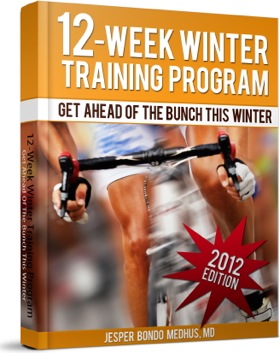
12-Week Winter Training Program Review.

General book information

The author Jesper Bondo Medhus studied at the University of Aarhus in Denmark and is an MD. He has a special interest in cycling and it’s physiology with particular attention to winter training programs. The book contains a 12-week winter training program both for cycling and weights and claims to (quotes directly http://www.training4cyclists.com/12-week-winter-training-program/)

  • Optimize your training regime using both indoor and outdoor riding
  • Zone in on how to get the best from sub-threshold and threshold sessions
  • Outline how to integrate strength training into your training

The book is available currently from http://www.training4cyclists.com/12-week-winter-training-program/ priced $29.95.

Review

I asked myself before reading this book “why would the Author want to write 12-week winter training program book”. Without much though my answer was to provide direction, structure and purpose to the cyclists winter training in order to see rewards in the spring/summer.

The book is written by an MD without the MD language. The descriptions, detailing and layouts are easy to understand and provide brief and sufficient information to complete the 12-week winter training program in a professional and confident manner. The book starts of by detailing how last year’s season should be evaluated and how lessons can be learned and implemented for the coming season. Motivational and personal scheduling skills and techniques are also discussed. The author discusses the indoor and outdoor cycling approaches along with the benefits of the ergometer for power measuring. Prior to the actual 12-week winter training program the author provides the reader with enough information to prepare and structure their schedules/lives in order to improve their training volume from 4 hours per week to 10 or more hours per week.

Discussed topics for the 12-week winter training program are Spinning, Power Meters, Performance tests, Training Intensities and a few others. The author discusses all the relevant details needed for the reader to perform intervals either in spinning classes or on the road using a power meter. All of the skills needed to complete the scheduled training spins during the 12-week winter training program are detailed out in the book. A 12-week winter training (weights) program is also scheduled for the rider who lifts weights during the off-season and can be easily run parallel to the prescribed cycling workouts. Again the author details out how the weights routine should be executed. Other topics detailed below are:

  • Making the Most of the Winter Months 
  • Power of Being Proactive
  • Spinning
  • Power Meter: Dawn of a New Era
  • Five tips for better performance tests 

As for the actual workouts themselves the author details out the intensities and how to get the correct values from testing protocols (which the author also explains). Intensities such as Threshold and VO2 max are explained with their impact on the body described.

Example: 1.5 hours – 5 x (4+2min) Sub-threshold / active recovery

  • 20min warm-up (start slowly and work your heart rate up in small steps to about 80%)
  • 4min Sub-threshold (80-87% of maximum heart rate / 80-90% of threshold power)
  • 2min Recovery ( <65% of maximum heart rate / <55% of threshold power)
  • 4min Sub-threshold (80-87% of maximum heart rate / 80-90% of threshold power)
  • 2min Recovery ( <65% of maximum heart rate / <55% of threshold power)
  • 4min Sub-threshold (80-87% of maximum heart rate / 80-90% of threshold power)
  • 2min Recovery ( <65% of maximum heart rate / <55% of threshold power)
  • 4min Sub-threshold (80-87% of maximum heart rate / 80-90% of threshold power)
  • 2min Recovery ( <65% of maximum heart rate / <55% of threshold power)
  • 4min Sub-threshold (80-87% of maximum heart rate / 80-90% of threshold power)
  • 2min Recovery ( <65% of maximum heart rate / <55% of threshold power)
  • 30min Endurance training (65-80% of maximum heart rate / 55-80% of threshold power)
  • 10min cool down (<65% of maximum heart rate / <55% of threshold power)

The actual 12-week winter training program and the 12-week winter training (weights) program are laid out in a very easy to read fashion. Each week (numbered 1 – 12) is laid out in individual days (1-7) in a table format with the days prescribed workout in a box of its own. Each week also has a narrative with it, explaining what the individual sessions are and what is trying to be achieved with the session. How to complete the prescribed workouts is also discussed. Couldn’t be any easier!.

This book is not a detailed in-depth description of physiological responses to training or has it any power to weight ratios or fancy charts to baffle the individual rider. Rather it is a concise book which will bring the casual or recently committed rider from his first or second year racing to the next level. It will provide all the tools needed for riders with basic or even no knowledge to structure their cycling, stay focused and move on to the next level of competition.

I’ve also asked myself the question of whether the book would improve more advanced riders. After some deliberation I’ve come to the conclusion that some of the more talented riders would gain more from the direction provided by the author. When one looks at 1st Cat riders year in year out competing at the same level and making the same mistakes over the last 5 – 10 years maybe the could sit down with a good book like this and educate themselves as to how to structure their winter time to produce solid and beneficial results.

Our final note before the authors last word is that this book is well laid out, provides the relevant detailed information for a rider from 4th through to 1st Cat, to structure and develop themselves and their commitment to training and racing into a productive and professional system. We would recommend this book to all levels of cyclists. Enjoy the miles!

The authors last word:

“The road to success is a long journey of victories, defeats, adjustments and hard work.”

Recomended Reading:

Posted in Reviews | Tagged , , , , , , , , , , , , , , | Leave a comment

12-Week Winter Training Program by Jesper Bondo Medhus

About the Author: Jesper Bondo Medhus is the medical doctor and cycling coach helping cyclists to ride faster with less training. He has compiled a very successful e-book with his best training techniques for time limited athletes.

Sports  Exercise Engineering will be reviewing this latest edition from the Training4Cyclists Hall of fame over the next couple of days.  Other notable books from Jesper include “Time Effective Cycling Training” which can be also purchased for the training4cyclists site below.

http://www.training4cyclists.com/12-week-cycling-winter-training-program/

Posted in Reviews | Tagged , , , , , , , , , , , , , | 3 Comments

Perfect Fitness App Review

Perfect Fitness Plus

Perfect Fitness App | Perfect Fitness Plus App                                                               for the Iphone, Ipad, and Ipod Touch

 
I’ve just had a look at this All from Perfect Fitness for the Mac people fo this world  and it seem to be quite a nice piece of kit….images to show you how to do your exercises, the exercise are broken down into various difficulty levels, easy to advanced… with over 300 different exercises to choose from…nutrition monitoring program..a hydration program which looks at the colour of you urine and deals with pre and post workour weights to determine hydration values…..you can also create your own workouts or maybe take the Perfect Fitness App that allows you on the go to learn new exercises.

Winter Training Sessions from Sports and Exercise Engineering and add them to your program…it’s a good piece of kit for the athlete looking after him/her self or the individual loosing weight or just gaining some fitness.

Unfortunatley I run Android myself and am not going to be able to use this until they release the droid version. But I would suggest that this app is good and will be of a benifit to most athletes and individuals for keeping all their training in one place….lets hope they move into the HR/Power market and link up training progress and adaptions.

http://www.facebook.com/pages/Perfect-Fitness-Plus/156400064382170  http://perfectfitnessapp.com/

Posted in Reviews | Tagged , , , , , , , | Leave a comment