Relationship Between the Talk Test and Ventilatory Thresholds in Well Trained Cyclists

Relationship Between the Talk Test and Ventilatory Thresholds in Well Trained Cyclists

Rodríguez-Marroyo, Jose A.; Villa, Gerardo; García-López, Juan; Foster, Carl

Published Ahead-of-Print

The aim of this study was to extend the range of populations where the Talk Test (TT) might be used as a marker of physiologic thresholds. Eighteen highly-trained cyclists underwent two incremental tests. One test included measurement of respiratory gas exchange to determinate the ventilatory (VT) and respiratory compensation (RCT) thresholds. On a separate day, a TT was performing using the same exercise protocol. During TT subjects read a standard paragraph at the end of each stage. The first stage at which the cyclist could not talk comfortably and could definitely not talk were referred to as the equivocal (EQ) and the negative stages (NEG), respectively. There were no significant differences in workload, heart rate, lactate and rating of perceived exertion (RPE) between VT (3.7 +/- 0.4 W[middle dot]kg-1, 150 +/- 10 bpm, 1.6 +/- 0.3 mm[middle dot]l-1 and 4.1 +/- 1.4, respectively) vs. EQ (3.6 +/- 0.4 W[middle dot]kg-1, 148 +/- 12 bpm, 1.3 +/- 0.5 mm[middle dot]l-1 and 3.8 +/- 1.2, respectively) and RCT (5.3 +/- 0.4 W[middle dot]kg-1, 177 +/- 7 bpm, 4.0 +/- 0.9 mm[middle dot]l-1 and 7.2 +/- 1.0, respectively) vs. NEG (5.3 +/- 0.5 W[middle dot]kg-1, 176 +/- 10 bpm, 4.2 +/- 1.3 mm[middle dot]l-1 and 6.8 +/- 1.5, respectively). We found significant relationships (p < 0.01) between VT & EQ and RCT & NEG for workload (r = 0.86 and 0.94, respectively), HR (r = 0.79 and 0.92, respectively) and RPE (r = 0.79 and 0.88, respectively). In conclusion, the present study showed that the EQ and NEG stages of the TT can be used as a simple and practical surrogate of the VT and RCT in highly-trained cyclists.

(C) 2012 National Strength and Conditioning Association

Posted in Reviews, Training | Tagged , | Leave a comment

Power Meter Service and Repair (Program PM 2013)

Its that time of year again. If you haven’t had your power meter serviced then send it on to us and we’ll do it. Power Meters are serviced in Galway. If you have an old Power Meter lying up in the shed or in the attic please wrap it up and send it on to us. We have so many talented young riders in ireland  who cannot afford the cost of a brand new Power Meter so please take the effort to send it on to us and we’ll endeavor to get it working and put it to good use on the new talent that our sport needs for a clean and honest future. Please support (Program PM 2013).

A Few Power Controls about to be repaired and serviced.

These are going to one of the best homes in the country at the moment and the DS for these riders should be proud of what he’s doing. So if you have an old Power Meter send it on and lets get up to speed with the rest of Europe and 80% of last years Tour de France riders.

Posted in Reviews, Training | Tagged , , , , , , , | Leave a comment

Intervals all year round…..this should be the norm!

It should be said that while interval training was present throughout most of the training year it definitely did not make up the bulk of training in either Seiler’s study or Salazar’s program, or even Zatopek’s for that matter. In fact, across the year, interval training only comprised 15-20% of total training. That said, it was present and emphasized throughout the athletes’ development – for most of the year, every year.

At first glance, this may seem to fly in the face of the principle of specificity. Make no mistake, it does! If we take a look at the elite marathoners from the time of Zatopek on, from Buddy Edelen to Shorter to Deek to Salazar to the African champs of today, only a very small amount of training is indicated at actual race pace. Instead, training is focused on the specific training intensities that maximally train a given fiber type.

One of the most practically applicable training studies that I have come across to date is the study by Dudley et al (1982) which investigated the biochemical adaptations of the different fiber types to varied intensities and durations of training. The figure below summarizes their findings

In the figure above (adapted from this study), the x axis represents intensity (%VO2max), the y axis represents aerobic adaptation in the form of cytochrome c concentration (nmole/gm). As you can see, slow twitch fibers were maximally (aerobically) trained at an intensity of ~83% of VO2max (approximately equal to the anaerobic or ‘functional’ threshold. FOG fibers were maximally trained at anywhere from 83-116% of VO2max, while FG fibers weren’t significantly trained until the workload exceeded 100% of VO2max, and weren’t maximally trained until the workload reached 116% of VO2max.

An additional study that has particular relevance to the optimal duration/intensity combination for slow twitch fibers was that of Harms and Hickson (1983). In this study, the researchers found a near linear relationship between duration of work and adaptation of slow twitch fibers. In other words, providing a minimal intensity of training was maintained (60%VO2max), doubling training volume elicited performance improvements of 40-100%. When we compare to the improvements in Dudley’s study, it becomes clear that in the case of slow twitch fibers duration and frequency trump intensity.

Seiler’s studies along with similar studies on runners by Esteve- Lenao et al. (2003) and cyclists (Lucia et al, 2000) show the majority of training volume to occur at ~60% VO2max, i.e. the mimimal intensity in which ST fibers are significantly trained. This intensity significantly (though not maximally) trains the slow twitch muscle fibers, however, it requires minimal CHO contribution and so can be maintained day after day. In accordance with Harms and Hickson’s study, the ability to perform greater duration and frequency at this intensity trumps any improvement that the athlete would receive by increasing the intensity.

FOG fibers on the other hand are a little different. As mentioned, maximal aerobic adaptation in the Dudley et al. study occurred anywhere from 85-116% of VO2max. In fact, 15 minutes of work in excess of VO2max elicited almost equal adaptation in FOG fibers to 60-90 minutes of threshold training. This may explain why tempo/threshold training has not been a universal training method for all world class runners. It would seem that at least some athletes can obtain similar results from interval training. In fact, at least in Seiler’s study, the elite XC skiers studied performed only ~5% of work between VT1 and VT2

Now, the kicker, FG fibers are not trained below the anaerobic threshold and not significantly trained below VO2max. In fact, these fibers were maximally trained at 116% of VO2max!

As a confirmed ‘slowtwitcher’ you may be saying “so what? I don’t care about my fast twitch fibers, I gave up that fast stuff years back”. However, this statement is ignoring one very important physiological truth:

“The anaerobic fibers of today become the aerobic fibers of tomorrow”

In other words, while you may not ‘need’ your 250W fibers for your current Ironman performance, it is prudent to devote a small amount of training time to keep them around. Who knows? You may need them a few years from now 🙂 Actually, from a truly scientific perspective, a part of the above statement is highly contentious. There is significant debate as to possibility of FT->ST conversion. However, the smart money (such as that of Ed Coyle) falls on that side of the fence. Additionally, the concept has been proven with sufficient stimulation in rats. Overall, I’m leaning towards this possibility. However, even if you’re not willing to concede that ‘truth’ you have to at least recognize the universally accepted notion of FTb->FTa conversion. This is a conversion that you can ‘use’ in your development as an Ironman athlete, a race which does elicit significant energy contribution from FTa or FOG fibers.

Actually, one of the key adaptations that we see in muscle biopsies of elite endurance athletes is a near 100% conversion of FTb->FTa fibers. In other words, training these anaerobic fibers to be aerobic is a key objective. Now, the reality is, to train a muscle fiber, first you must recruit it, and as the chart indicates, there is minimal FTb recruitment below the anaerobic threshold. So, some of our training should be done in excess of the anaerobic or functional threshold.
It is important to remember that these peripheral adaptations are ‘basic qualities’ that requires at best years of adaptation to achieve a full FTb->FTa conversion, and potentially a decade for the FTb->ST conversion (Coyle, 1999). So, you’d better start now. 🙂

Now, this doesn’t mean that you need to line up along side Maurice Green for a series of track repeats. In fact, the recruitment of FG fibers is much more dependent on load than speed. But whatever modality you choose (strength work, short hill repeats, big gear power intervals on the bike, tethered swimming), if you want to aerobically train all fiber types a small portion of your energy during your week should be devoted to exercises performed at a high work load. This is at least as (if not more) important than training at moderate intensities (mod-hard to threshold).

Fast twitch training isn’t without it’s problems, however, namely great glycogen depletion and muscle acidity that can damage muscle and exacerbate recovery requirements. There are, however, some tricks that we can play with the interval duration and recovery that can significantly mitigate these negative effects and make speed work much ‘safer’.

These tricks were discovered many many years ago by Hans Reindell and Woldemar Gerschler and used to great effect by such athletes as the great Emil Zatopek. Recently, these tricks have been confirmed experimentally by folks such as Tabata (1997), Stepto (1998), Hawley and Noakes (1997) and Billat (1999).

So what are the tricks?

1. Use short intervals (ONLY) during the base period.

Essen (1978) found that providing the length of the training interval was kept short (15-30s), exercise performed in excess of VO2max elicited glycogen depletion patterns and lactate levels much more in accordance with tempo or threshold training, i.e. 2-4mmol/L lactate even when continued for 30-60 minutes (i.e. 30-60 repetitions). These intervals do not provide the same level of stress on the central systems as long intervals, therefore long intervals or time trials are indicated for a short period of time prior to competition to truly peak an athlete, however, in terms of maximizing peripheral adaptations in FG fibers, 30-60 reps of 15-30s with a 15s-1min rest period is optimal.

2. Utilize active recovery between intervals at 50% of vVO2

Brooks (1978) found that lactate removal is facilitated almost two-fold by utilizing active recovery between bouts. Additionally, Billat (1999) found increased ability to remove lactate in athletes who followed a short interval training program with active recovery vs. one with passive recovery.

3. Only perform as many repetitions as you can while holding appropriate quality.

Gerschler’s rule of thumb was the intervals should only be continued until the HR fails to drop to 120bpm within a given recovery period (30-90s dependent on the length of the interval) while target pace is held constant. While the 120bpm figure may be arbitrary, the concept that decreased recovery heart rate reflects greater anaerobic contribution is solid. For shorter intervals, one could argue that the recovery HR is a better indicator due to CV lag time. Either way, when either power/pace drops, or working or recovery HR significantly changes for a given power/pace output, it is time to shut it down.

Hopefully, this post has illuminated the relevance of speed and strength training for endurance athletes. While we do not have the same objectives for our FTb fibers as speed and strength athletes, we still need them! By doing your bit to keep these fibers alive and kicking throughout your athletic development, they will be ready and waiting when you need them the most as you approach the Zenith of your personal athletic potential.

Courtsey of: http://www.endurancecorner.com

Posted in Reviews, Training | Tagged , , , , , | Leave a comment

Periodization Paradigms in the 21st Century: Evidence-Led or Tradition-Driven?

Again I reiterate my stance on fatigue profiling riders. Eliminating weaknesses at a certain point in a riders development will bring the largest gains in performance.

Periodization Paradigms in the 21st Century: Evidence-Led or Tradition-Driven?


2012, 7, 242 – 250

The planning and organization of athletic training have historically been much discussed and debated in the coaching and sports science literature. Various influential periodization theorists have devised, promoted, and substantiated particular training-planning models based on interpretation of the scientific evidence and individual beliefs and experiences. Superficially, these proposed planning models appear to differ substantially. However, at a deeper level, it can be suggested that such models share a deep-rooted cultural heritage underpinned by a common set of historically pervasive planning beliefs and assumptions. A concern with certain of these formative assumptions is that, although no longer scientifically justifiable, their shaping influence remains deeply embedded. In recent years substantial evidence has emerged demonstrating that training responses vary extensively, depending upon multiple underlying factors. Such findings challenge the appropriateness of applying generic methodologies, founded in overly simplistic rule-based decision making, to the planning problems posed by inherently complex biological systems. The purpose of this review is not to suggest a whole-scale rejection of periodization theories but to promote a refined awareness of their various strengths and weaknesses. Eminent periodization theorists—and their variously proposed periodization models—have contributed substantially to the evolution of training-planning practice. However, there is a logical line of reasoning suggesting an urgent need for periodization theories to be realigned with contemporary elite practice and modern scientific conceptual models. In concluding, it is recommended that increased emphasis be placed on the design and implementation of sensitive and responsive training systems that facilitate the guided emergence of customized context-specific training-planning solutions.

Keywordsemergent, biological complexity, athletic training, planning solutions

Authors: John Kiely

also see:

http://sportsexerciseengineering.com/2011/08/11/orthostatic-hr-fatigue-profiling/

http://sportsexerciseengineering.com/2011/08/14/rider-fatigue-profiling-during-2011-2012-coaching-project/

Article courtesy of:

http://journals.humankinetics.com/ijspp-current-issue/ijspp-volume-7-issue-3-september/periodization-paradigms-in-the-21st-century-evidence-led-or-tradition-driven

Posted in Reviews, Training | Tagged , , , , | Leave a comment

Theory of Planning your Training Program

In order for an athlete to be competitive at the specific times during the sporting calendar an athlete needs to be organized and take time to plan their calendar for competition and testing. The calendar has to be simple suggestive and be easily modified in order to facilitate changes due to the athletes rate of progress. It must also be realistic and consider the athletes potential in its goals. Negative issues such as crashes, illness, personal issues can all interfere with the calendar hence the need for it to be easily modified.

The Annual Plan

This is a one year training plan and should be based on the concept of periodization and good principles of training. A methodical approach to reach a seasons peak performance should be taken either for a single season peak or a multi season peak. I the athlete is targeting a single season peak then this would be longer and more intense in duration than a multi season peak. We can break the plan down in to three separate phases. For a single peak it would look like:

Preparation Phase, Competitive Phase & Transition Phase

For the double peak phase it would look like:

Preparation Phase, Competitive Phase, Transition Phase, Preparation Phase, Competitive Phase & Transition Phase.

The Preparation Phase (PP) is the longest phase and is for preparing the athletes base. Different cycles and specifics within the PP will vary depending on weakness which became evident from the previous years competition, illness or injury.

The Competition Phase (CP) contains the main peak for the season. It will also contain some pre-peak competitive events for specific adaptions only available with racing and also it will contain some specific preparatory training session with some loading and unloading of specific fatigue.

The Transition Phase (TP) is where the athlete allows his/her biological regeneration, psychological rest and relaxation to take place. This could last up to 5 weeks but the general norm would be 3 – 4 weeks.

The above Phases are considered a Macrocycle. In general the Preparation Phase (PP) lasts for 65 – 75% of the Macrocycle. This is then broken down into Mesocycles and  Microcycles. A Mesocycles would last from 2 to 6 weeks with a microcycle lasting a week. So in a month or 4 week Mesocycle we would have 4 Microcycles. Contained in the Mesocycle we would have 3 Microcycles containing specific work and 1 Microcycles containing recovery. The Microcycles is nearly always different from week to week depending on where it is in the Mesocycle and Macrocycle. The competition last 15 – 20% and contains preperation races and the main peak followed by a few post peak races as performance declines. The competition phase is back-ended by the transition phase which would generally be 10% in duration.

If you spend some time at the kitchen table with next years calendar and the end of this years you will see benefits to your performance for 2013.

Posted in Reviews, Training | Tagged , , , , , , , , , , , , , | Leave a comment

Why Strength Endurance is Important!

Over the last number of years Power Meters have become an important part in 80% of the riders who ride the Tour de France every year. Most of these riders are the elite of cycling from around the world. That in itself is a clear indication that training with a power meter must offer some advantage over the previously used Hear Rate only system.

Power Meters have also changed the focus of some coaches to a more mechanical view of a riders pedal stroke rather than a performance view.

Lets look at increasing power. One of two things needs to happen,

1. Increase pedal speed (Revolutions per Minute)

2. Increase the pedal force (Torque)

If we have a rider super fit and at 120rpm their seems to be nothing left for that rider to do to increase speed other than if he/she increases pedal force. So if a rider is aerobically fit but lacks the necessary strength then he/she is out of the equation.

Neumann (2000) conducted a vast amount of biopsy studies on strength endurance athletes and found that the optimal relationship between fast and slow twitch muscle fibers was 1:3:1. This is the size ratio and not the percentage ratio.

When building this ratio it comes with detriment to the aerobic system. The increase in size of the fibers needs to be supported by the aerobic system. This is a challenge from an exercise prescription stance but good coaches can deal with this problem very easily. Also in increasing strength the riders find that their aerobic system has more to offer and previously hadn’t been training to it’s maximum.

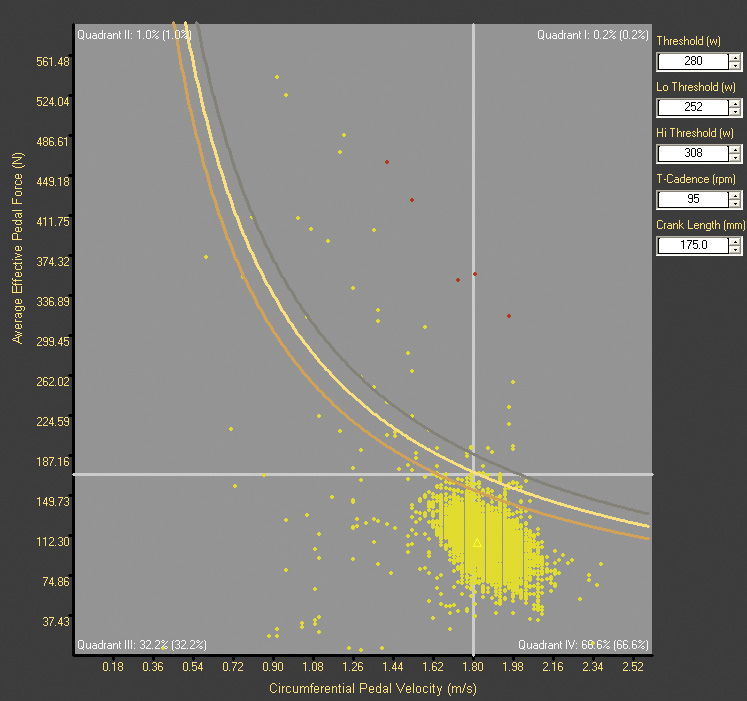
It is also very important to prescribe strength building workouts based on torque values in order to achieve the correct adaptions. As we know the current power meters don’t display torque values so it is important that the coach transfer the correct torque values for the prescriptions by way of calculations. The rider will receive a power and cadence value which will be equal to a specific torque. 300w at 100rpm has a different value torque as opposed to 300w at 35rpm. Again a good coach will be able to prescribe this. This type of training can not be done on Heart Rate Only!

Low torques over longer durations increase muscular endurance while high torque values over short durations will increase strength.

Unfortunately in Ireland we do not have any mountains only a few hills. In order to achieve torques sufficiently high enough riders should be using a 55 or 56 chain ring with an 11/12 sprocket. This will generate the required torque for the adaptions to take place. Riders on the continent can easily generate these torque on long climbs of an hour or more at slow speeds and low cadences.

I’ve attached a study “Effects on the crank torque profile when changing pedaling cadence in level ground and uphill road cycling” just to highlight the difference between torque on flat roads compared to climbing” Journal of Biomechanics 38 (2005) 1003–1010

Also see:

http://sportsexerciseengineering.com/2012/10/09/one-reason-why-high-resistance-low-cadence-work-is-important/

http://sportsexerciseengineering.com/2012/10/03/combining-explosive-and-high-resistance-training-improves-performance-in-competitive-cyclists/

http://sportsexerciseengineering.com/2012/07/10/professional-cyclists-bike-strength-training/

Abstract

Despite the importance of uphill cycling performance during cycling competitions, there is very little research investigating uphill cycling, particularly concerning field studies. The lack of research is partly due to the difficulties in obtaining data in the field. The aim of this study was to analyse the crank torque in road cycling on level and uphill using different pedaling cadences in the seated position. Seven male cyclists performed four tests in the seated position (1) on level ground at 80 and 100 rpm, and (2) on uphill road cycling(9.25%grade)at60and80rpm.The cyclists exercised for 1 min at their maximal aerobic power. The bicycle was equipped with the SRM Training System (Schoberer, Germany) for the measurement of power output (W), torque (Nm), pedaling cadence (rpm), and cycling velocity (kmh1). The most important finding of this study indicated that at maximal aerobic power the crank torque profile (relationship between torque and crank angle) varied substantially according to the pedalling cadence and with a minor effect according to the terrain. At the same power out put and pedaling cadence (80rpm) the torque at a 45 degree crank angle tended (po0:06) to be higher (+26%) during uphill cycling compared to level cycling. During uphill cycling at 60 rpm the peak torque was increased by 42% compared with level ground cycling at 100 rpm.When the pedalling cadence was modified, most of the variations in the crank torque profile were localised in the power output sector (45d to 135d).

2004 Elsevier Ltd. All rights reserved.

Posted in Reviews, Training | Tagged , , , , , | 1 Comment

FATIGUE FORENSIC: WHAT REALLY MAKES YOU SLOW DOWN

Fatigue Forensic: What really slow you down!

Traditionally, cyclists have viewed fatigue as an inescapably muscular event – a situation in which muscles are simply unable to function with a desired level of force production. However, new research indicates that fatigue can – and often does – occur when muscles are humming along quite nicely. This fatigue is produced by a neural regulator, and it is the cyclist’s task to fine-tune his/her regulating system.

If you carry out challenging interval workouts during your cycling training, you are studying the true nature of fatigue. After all, you have probably had the following experience: You decide on a workout at 40-K pace, say 10 X 2K in 3:23 each (we’ve selected a standard training session and a reasonable distance and velocity – and thus time – for each work interval; in this case, the speed is 35.5 kilometers per hour, or about 22 miles per hour). Your warm-up goes well, and you’re off and cycling!

The pace you have chosen is an ambitious one, but you are feeling great the first time through the 2-K distance, and you cover the initial 2000 meters in 3:15. The second one is 3:18, the third 3:21, and from the fourth one on you are struggling a bit to hit your target of 3:23 each time. For the most part, you stay on track, but one interval, we’ll say the eighth, slides up to 3:29.

The ninth feels really tough, but you hang in there and produce a 3:23. You have reached the point in the workout at which fatigue should be close to maximal. After all, you are a believer in the traditional concept of fatigue. You know that as you continue to cycle quickly, for one work interval after another, your intramuscular pH is dropping fast, reflecting the tide of hydrogen ions which are flooding your muscle cells (1). That devastating fall in pH is interfering with the release of calcium ions into your muscles’ sarcoplasmic areas (2), making it much-more difficult for your muscle fibers to contract forcefully (3). As a result, adhering to planned pace is becoming a major undertaking. 

And then, something magical happens! At the point when muscular fatigue is greatest, when pH has bottomed out, when calcium ions have been locked away for the day, when muscle contractility has ebbed, you uncork your best 2K of the day – a 3:12! Who said that cycling does not have its magical moments?

Huh? If muscle fatigue is truly a function of metabolic events happening inside muscles, that last 2000 should have been the slowest, not the fastest interval of the day. Our views of fatigue – and of what determines cycling velocity during workouts and races – must be wrong!

Indeed, that is what recent research carried out by Tim Noakes and colleagues at the University of Cape Town, the University of Stellenbosch, and the Sports Science Institute of South Africa is telling us. In this new investigation, eight healthy males (average age = 22 years) completed “anaerobic capacity” tests in the laboratory on a Monark friction braked cycle ergometer (4). To gain a better understanding of the nature of fatigue and of pacing strategies during high-power exertions, South-African researchers used an element of deception with the subjects. Specifically, the young men were informed that they would be completing four 30-second maximal trials, as well as one 33-second and one 36-second maximal effort on the bike. In reality, they completed two trials of 30 seconds, two tests of 33 seconds, and a duo of 36-second exams.

The deception took place in the following way: Prior to one of the 33-second tests, the cyclists were told that it was actually a 30-second exertion, and the same was true for one of the 36-second affairs. The researchers hoped to determine whether the subjects would subconsciously alter pace or strategy during the “informed’ 36-second trial (when they were told that the trial would last for 36 seconds), for example, compared with the “deception” 36-second trial, when the cyclists thought they would only be cycling for 30 seconds. The cyclists were allowed to watch a clock during all of their maximal exertions, but – ingeniously – the scientists had programmed the clock to run more slowly during the deception 36-second trial, so that it would tick 30 “seconds” during what was really a 36-second time frame.

You might expect that the cyclists would ride with more power, at least initially, during the deception-36 trial, compared with the informed-36 trial (since they thought that the deception-36 trial was going to be shorter in duration), but the results were more interesting than that. As it turned out, power output was exactly the same in the informed and deception 36-second trials, right up until the 33-second point, but then power fell significantly over the last three seconds of the deception trial!

How should we interpret that? Since the cyclists were able to perform more work when they were reliably informed about the duration of exercise, compared with when they had been deceived, some internal factor, not located in the muscles, must have controlled power output. If “peripheral fatigue” (fatigue centered in the muscles, as according to traditional theory) was the true factor controlling performance, then power outputs should have been exactly the same in the informed and deceived 36-second trials (because the extent of muscle fatigue would have been the same in these two trials of equal duration).

Source http://cyclingresearchnews.com/News_And_Events.php?cid=3&iid=92

Posted in Reviews, Training | Tagged , , , , , , , , , , | Leave a comment

10 Tips for Improving Recovery

Here are a few little tips to improve your recovery after training hard.

  1. At the end of your workout slow down to a Low Intensity. Don’t stop but ease down in your effort and allow lactic acid to clear. In cold weather it’s advised to put on another layer to keep warm, like your rain jacket for instance. Pull over throw on the rain cape and spin a light gear home.
  2. Before you go out on your training session you should weight yourself in your birthday suit. Then when you get back from training weight yourself again. For every Kilo difference you should replace that with water. Replacing these Lost Fluids is most important. And for those of you who think your loosing hugh amounts of weight forget it. 4000 cals = 0.45kg in fat burned
  3. In the last 30 mins of your training try and get some Protein consumed. This will start your recovery earlier. A protein bar or something you might have prepared and kept in your back pocket is a good start.
  4. Have a Massage. Read up on how to self massage with a foam roller. This will improve recovery and help you relax.
  5. Eat Early when your finished your training. The sooner you can get food into your system the better your recovery will be. Remember to get the carb-protein ratios correct.
  6. Sleep Well. Try and get as much sleep as possible even a quick nap for 10-15 minutes will start Growth Hormone release. Make sure you get that 8-10hr per night
  7. Having a nice bath. But make sure that this bath is full of ice. Some athletes find that the Ice Bath improves recovery and reduces (DOMS) delayed onset muscle soreness.

The last three 8, 9, & 10 along with many more world class Recovery methods we keep for our Elite Athlete Coaching Programs. Contact us at sportsexerciseengineering@gmail.com for more information.

Posted in Training | Tagged , , , , , , , , | Leave a comment

One Reason Why High Resistance Low Cadence Work Is Important.

In reading the Abstract below it is clear that as cadence increases efficiency increases, 22.4 ±1.7% @ 60rpm to 24.2 ± 2.0% @ 100rpm. The cyclists are less efficient at lower cadences so training at a particular wattage will elicit higher demands on the body for that wattage then it would at a higher cadence, say 300W tempo @ 55 rpm ‘V’ 300 W tempo @ 95rpm. The cyclists should burn less matches at the 95rpm. So if one trains at the lower cadences and becomes efficient does one then have a higher efficiency at the higher cadences?

Medicine & Science in Sports & Exercise (2004)
Volume: 36, Issue: 6, Pages: 1048-1054

Abstract

PURPOSE: To determine the effects of changes in pedaling frequency on the gross efficiency (GE) and other physiological variables (oxygen uptake (VO2), HR, lactate, pH, ventilation, motor unit recruitment estimated by EMG) of professional cyclists while generating high power outputs (PO). METHODS: Following a counterbalanced, cross-over design, eight professional cyclists (age (mean SD): 26 2 yr, VO2max: 74.0 5.7 mL x kg x min) performed three 6-min bouts at a fixed PO (mean of 366 37 W) and at a cadence of 60, 80, and 100 rpm. RESULTS: Values of GE averaged 22.4 1.7, 23.6 1.8 and 24.2 2.0% at 60, 80, and 100 rpm, respectively. Mean GE at 100 rpm was significantly higher than at 60 rpm (P < 0.05). Similarly, mean values of VO2, HR, rates of perceived exertion (RPE), lactate and normalized root-mean square EMG (rms-EMG) in both vastus lateralis and gluteus maximum muscles decreased at increasing cadences. CONCLUSIONS: In professional road cyclists riding at high PO, GE/economy improves at increasing pedaling cadences.

Posted in Reviews, Training | Tagged , , , , , , , | Leave a comment

Effects of low- ‘v’ high-cadence interval training on cycling performance.

J Strength Cond Res. 2009 Sep;23(6):1758-63.

Effects of low- ‘v’ high-cadence interval training on cycling performance.

Source

Health and Sport Science, Eastern Institute of Technology, Napier, New Zealand. CPaton@eit.ac.nz

Abstract

High-resistance interval training produces substantial gains in sprint and endurance performance of cyclists in the competitive phase of a season. Here, we report the effect of changing the cadence of the intervals. We randomized 18 road cyclists to 2 groups for 4 weeks of training. Both groups replaced part of their usual training with 8 30-minute sessions consisting of sets of explosive single-leg jumps alternating with sets of high-intensity cycling sprints performed at either low cadence (60-70 min(-1)) or high cadence (110-120 min(-1)) on a training ergometer. Testosterone concentration was assayed in saliva samples collected before and after each session. Cycle ergometry before and after the intervention provided measures of performance (mean power in a 60-s time trial, incremental peak power, 4-mM lactate power) and physiologic indices of endurance performance (maximum oxygen uptake, exercise economy, fractional utilization of maximum oxygen uptake). Testosterone concentration in each session increased by 97% +/- 39% (mean +/- between-subject SD) in the low-cadence group but by only 62% +/- 23% in the high-cadence group. Performance in the low-cadence group improved more than in the high-cadence group, with mean differences of 2.5% (90% confidence limits, +/-4.8%) for 60-second mean power, 3.6% (+/-3.7%) for peak power, and 7.0% (+/-5.9%) for 4-mM lactate power. Maximum oxygen uptake showed a corresponding mean difference of 3.2% (+/-4.2%), but differences for other physiologic indices were unclear. Correlations between changes in performance and physiology were also unclear. Low-cadence interval training is probably more effective than high-cadence training in improving performance of well-trained competitive cyclists. The effects on performance may be related to training-associated effects on testosterone and to effects on maximum oxygen uptake.

Posted in Reviews, Training | Tagged , , , , , , , | Leave a comment