Stage 4 Chris Horner SRM Power Profile (Team RSNT)

Chris Horner (Team RSNT)

Stage 4 of the 2012 Tour de France was 130 miles of mainly flat roads and shall we say a conservative approach from the riders for the most of the day, that was until the last 2 – 3km when a high speed crash ripped out most of the sprinters. Below is Chris Horner’s SRM file for the stage with an average power of 154 watts, cadence average of 65rpm, 5:45hrs on the bike and 38.65km/hr speed. A handy day according to himself!

Posted in Tour de France | Tagged , , , , , , | Leave a comment

Live Cycling Streaming, Tour de France, Tour of Austria & Vive le Velo.

Start time is Central Eastern and streaming wouldn’t start until then, it could be a few minutes before or after. Copy and paste the link into your browser.

04/07 Tour de France 2012 (14:10h CEST) : http://sports-livez.com/sopcast/sop-1.php

04/07 Tour of Austria 2012 (11:30h CEST) : http://sports-livez.com/channel/ch-4.php

04/07 03/07 Vive le Velo (21:35h CEST) : http://sports-livez.com/channel/ch-3.php

Posted in Live Cycling, Tour de France | Tagged , , , , | Leave a comment

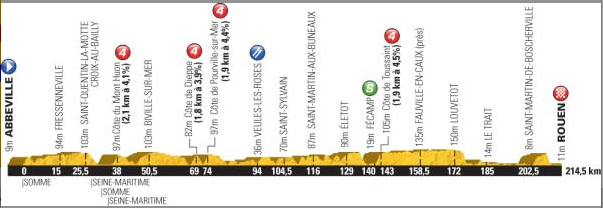
Tour de France Stage 4 Profile (2012)

Tour de France Stage 4 Profile
Image
Image
General classification after stage 3
Result
1 Fabian Cancellara (Swi) RadioShack-Nissan 14:45:30
2 Bradley Wiggins (GBr) Sky Procycling 0:00:07
3 Sylvain Chavanel (Fra) Omega Pharma-Quickstep
4 Tejay Van Garderen (USA) BMC Racing Team 0:00:10
5 Edvald Boasson Hagen (Nor) Sky Procycling 0:00:11
6 Denis Menchov (Rus) Katusha Team 0:00:13
7 Cadel Evans (Aus) BMC Racing Team 0:00:17
8 Vincenzo Nibali (Ita) Liquigas-Cannondale 0:00:18
9 Ryder Hesjedal (Can) Garmin – Sharp
10 Andreas Klöden (Ger) RadioShack-Nissan 0:00:19
11 Bauke Mollema (Ned) Rabobank Cycling Team 0:00:21
12 Maxime Monfort (Bel) RadioShack-Nissan 0:00:22
13 Janez Brajkovic (Slo) Astana Pro Team
14 Rein Taaramae (Est) Cofidis, Le Credit En Ligne
15 Peter Sagan (Svk) Liquigas-Cannondale 0:00:23
16 Jean-Christophe Peraud (Fra) AG2R La Mondiale
17 Marco Marcato (Ita) Vacansoleil-DCM Pro Cycling Team
18 Haimar Zubeldia Agirre (Spa) RadioShack-Nissan 0:00:24
19 Wouter Poels (Ned) Vacansoleil-DCM Pro Cycling Team
20 Nicolas Roche (Irl) AG2R La Mondiale 0:00:25

Information courtesy of ASO

Posted in Tour de France | Tagged , , , , , | Leave a comment

Tour de France power profiles (Peter Sagan Stage 1 Win)

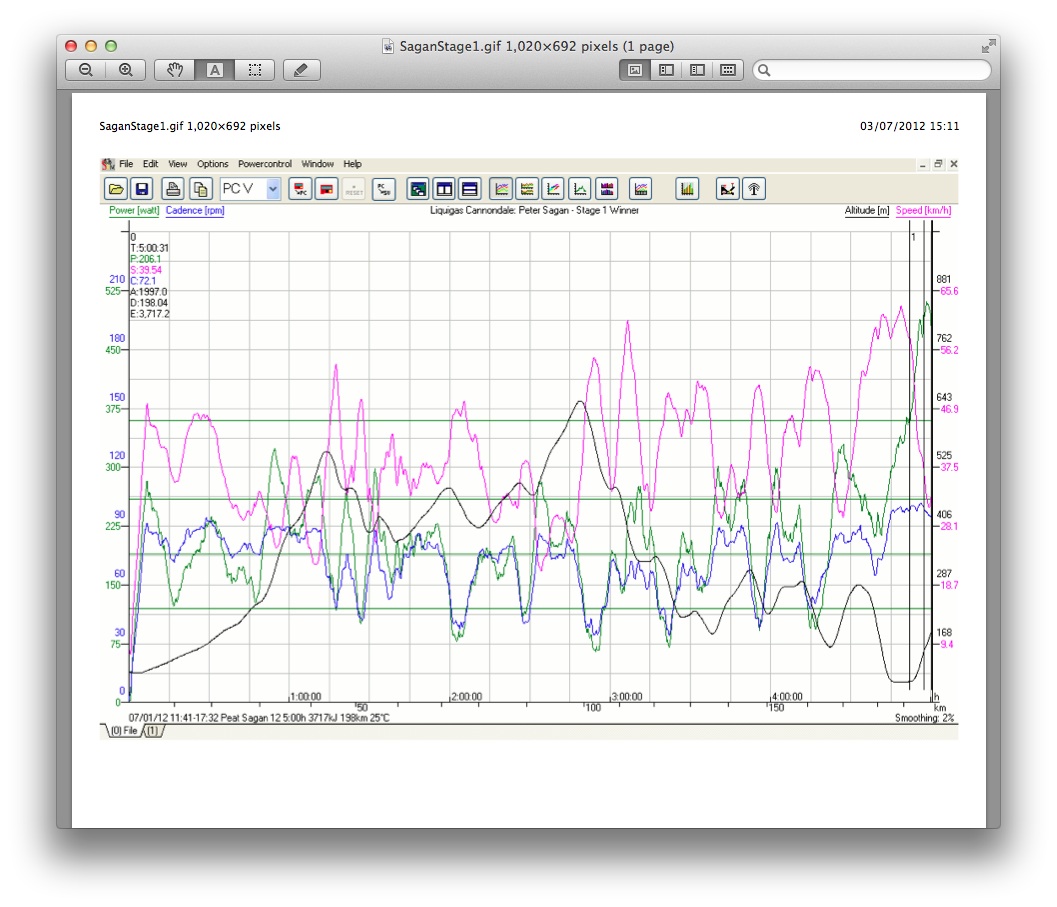
Peter Sagans power profile for his stage 1 win at this years Tour de France 2012

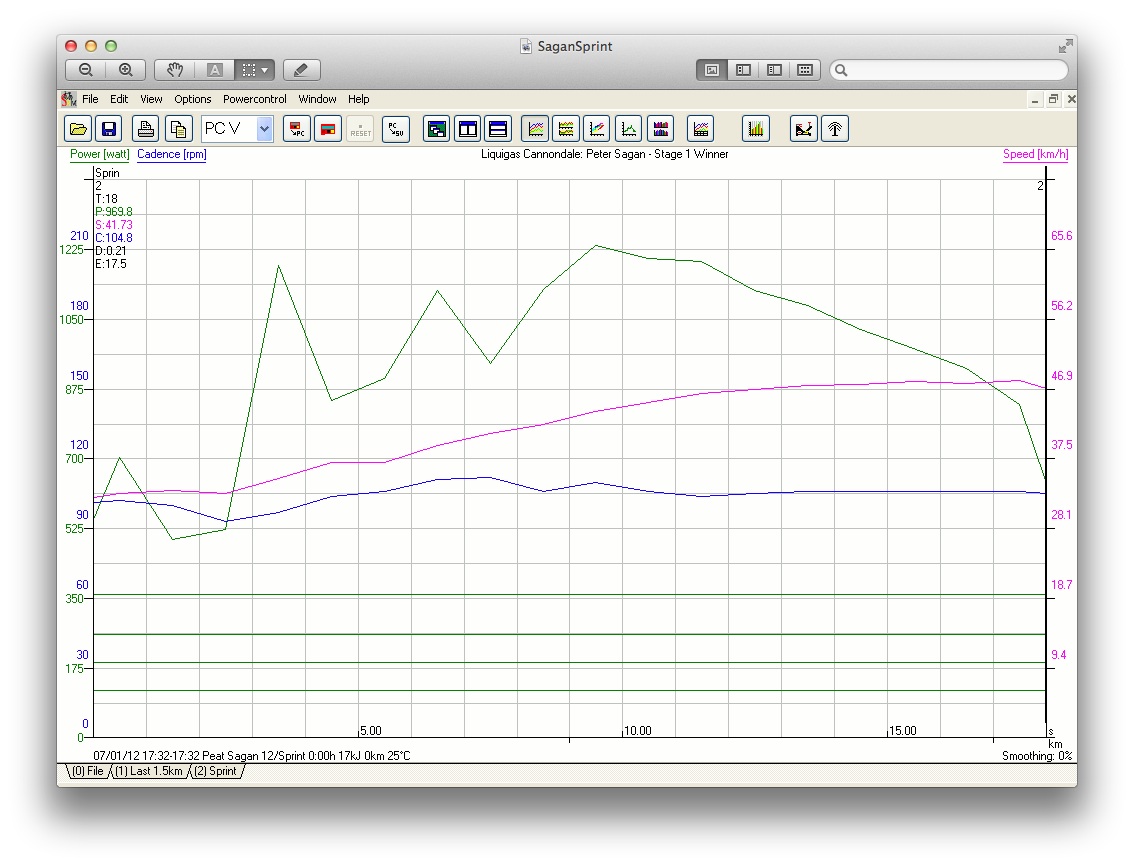
Sagan averaged 490 watts for the last 2.5 minutes of the stage and that was after 5 hrs on the bike

The last sprint to the line Sagan hit 1230 watts and averaged over 950 watts for the last couple of hundred meters.

Sagans stats for the stage:

Average: 210watts, cadence 72rpm with 2000 mtrs altitude gain and 3550 kilocals burnt.

Posted in Reviews, Tour de France | Tagged , , , , , , , , | 3 Comments

A general training model for the road cyclist

A general training model for the road cyclist

The training model presented here is based on the concepts and methods of New Zealand Olympic running coach Arthur Lydiard (1917-2004). With slight modifications, these can be summarized as follows:

1. Performance in any endurance activity (i.e., longer than 3 minutes) is largely determined by the available rate of aerobic energy production, and this common basis allowed Lydiard to successfully use the same training program for all his runners, from 800 meters through the marathon, until their period of specialization. Aerobic development is essentially unlimited; the only constraints are training opportunities(available time, environmental conditions), training capacity, motivation, and resistance to injury/illness.

“The wider and deeper the base, the higher and more sustained the peak.”

2. Aerobic capacity is developed through at least 10-12 weeks of mainly steady-state tempo/threshold runs of ~2 hours long, totaling ~8-12 hours per week. The goal of this is increased energy production at lactate threshold (“endurance” or “metabolic fitness”) by inducing peripheral adaptations (i.e., within the working muscles), including increased capillary density (allowing greater removal of waste metabolites), increased mitochondrial mass (which improves muscle respiratory capacity), and interconversion of slow-twitch muscle fibers (which improves cycling economy). Aerobic power may be ‘peaked’ toward the end of this period with once-a-week, intermediate-intensity interval workouts (e.g., 5 × 5 minutes).

3. The distribution of energy expended during aerobic workouts should be governed by the interaction of intensity and perceived exertion, such that there is a greater second-half output in each session, leaving the athlete exhausted only at the very end, feeling “pleasantly tired” shortly afterward, and thus able to sustain a gradually progressive training load almost indefinitely; workouts may be somewhat challenging to complete, but not a struggle, with something always left in reserve. “You must exhaust the body systematically and sensibly. Not go ahead and kill yourself,” Lydiard summed up in a 1964 interview, and his frequent refrain of “Train, don’t strain,” is now justifiably famous. Recently, a client captured this perfectly another way: “Work, don’t suffer.”

4. Since the metabolic strain of sprint training is limited, speed can and should be developed throughout the year with short, intense efforts of no more than 15 seconds, with emphasis on technique and form.

5. When aerobic conditioning has proceeded as far as possible, ~7 weeks are devoted to anaerobic capacity training (4 weeks lower-intensity hill workouts, 3 weeks high-intensity repetitions) during which aerobic fitness is maintained. The reason for this sequencing is not so much that aerobic training is needed to prepare for anaerobic workouts, rather, the latter interferes with and limits the former, and so should be forestalled until aerobic fitness is as complete as possible, then be applied in a concentrated manner, as a kind of “icing on the cake.”

6. This is followed by a 4-week ‘coordination period’ of over-and under-distance training races and/or other specific workouts meant to simulate the neuromuscular demands and variable pace of competition.

7. Finally, 7-10 days of ‘sharpening and freshening’ leaves the athlete rested and in peak form for a period of competition and recovery. This approach can be applied to cycling in a quantitative manner with the power-based training levels laid out by exercise physiologist Andrew Coggan, Ph.D., as well as the analytical tools he has created: Training Stress Score (TSS), Chronic and Acute Training Load (CTL and ATL), and Training Stress Balance (TSB). All of these are incorporated in the Training Peaks WKO+ Performance Manager. Perhaps because they feel threatened by them, some coaches are quick to condemn and dismiss training models as “cookie cutter” or “pre-fab” in nature, and insist that all training must be individualized. The question is, individualized from what? Preparation for any given event arises from known demands and is governed by established underlying principles, so a logically-constructed model can provide, at the very least, a useful starting point for most any runner or cyclist (savvier coaches take advantage of this by offering power- and pace-based training plans designed for specific goals). It is certainly true that different athletes can respond in significantly varying degrees to a particular workout, or have varying training load capacities as well as recovery needs, yet this is akin to the exception that proves the rule: most responses fall within a predictable range.

Thus, no model program should be applied rigidly, but must be adapted to the athlete for whom it is intended. In addition to physical constitution, other factors that shape the training prescription include competitive priorities/preferences (which races you want to do well in, which you want to use for training, and which you enjoy the most, since motivation determines how diligently you train), role within a team, age, training status/history, individual characteristics (strengths and weaknesses), weather, training opportunities (e.g., local availability of roads/trails, terrain, traffic), work schedule and other responsibilities, etc. A coach can provide valuable aid in offering objective advice as well as customizing and adjusting the training plan.

BY CHARLES HOWE

Over the weekend I will develop a flow chart based of the above description which will allow the athlete develop his/her own program for the following season..2013. I will try to get it posted for Monday a some stage but due to me starting the National Masters Championships on Saturday my attentions shall be elsewhere. Good luck to all athletes in their prospective National Championships over the coming weekend and chapeaux to you all for getting to the start line.

Posted in Training | Tagged , , , , , , , , , | 1 Comment

Power Meter Service, Maintenance, Calibration and Adivce

Sports and Exercise Engineering are now providing a service for the maintenance, calibration and service of all market power meters. We are based in Galway and can turn around your meter in half the time, cost and hardship you get sending units to the continent. Drop us a mail at sportsexerciseengineering@gmail.com or call us on +353 87 2453114.

If you have and old power meter lying in the shed or under the bed, pull it out and get it fixed. If youv’e packed the bike sell if to someone who’s going to use it!

Posted in Uncategorized | Leave a comment

EFFECTS OF AEROBIC AND ANAEROBIC TRAINING PROTOCOLS ON 4000M

This is a Thesis which was submitted to the Graduate Faculty of the Louisiana State University Department of Kinesiology.

http://etd.lsu.edu/docs/available/etd-11112004-093751/unrestricted/Cheramie_thesis.pdf

Posted in Reviews | Tagged , , , , , , , , , , , , , , , , , | Leave a comment

Educational read for those of you self prescribing your own traing plans.

http://www.freewebs.com/velodynamics2/modelplan.pdf

Posted in Reviews | Tagged , , , , , , | Leave a comment

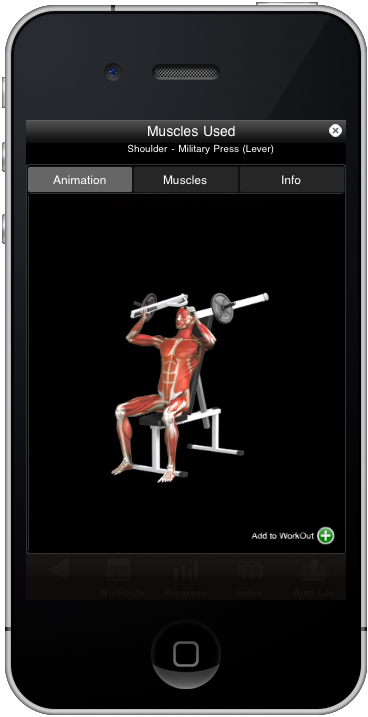
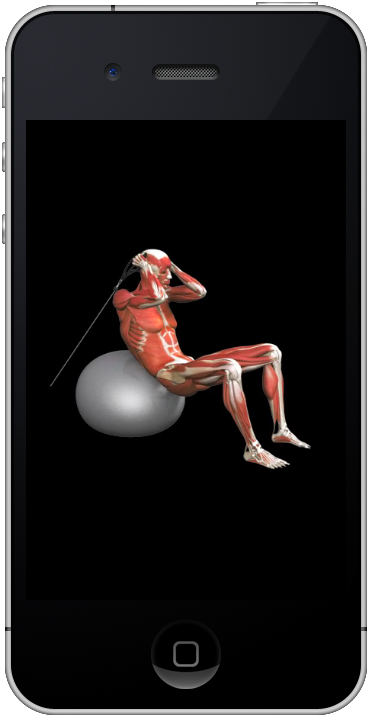
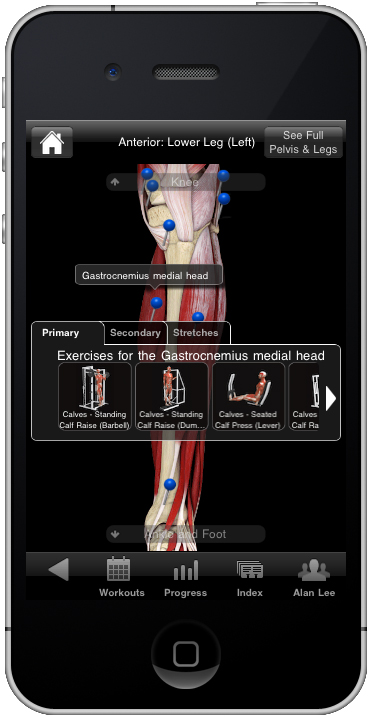
“iMuscle” App (Nova Series)

“iMuscle” app

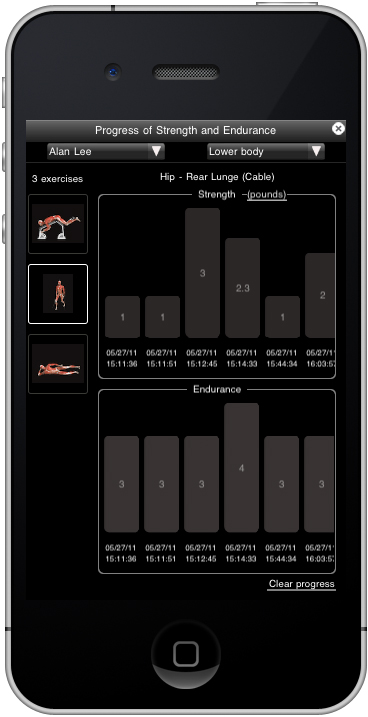
We’ve just got the electronic press kit for the new “imuscle” app. Looks pretty cool and seem to provide a good tracking capability of progress. I’ve posted a few screen layouts as we are still waiting on the program to we can run it and review thoroughly.

http://applications.3d4medical.com/imuscle.html

Posted in Reviews | Tagged , , , , , , , , , , , , , , | 1 Comment

Study shows massage reduces inflammation following strenous exercise and promotes growth of new mitochondria

Researchers from Buck Institute for Research on Aging and McMaster University in Hamilton Ontario have published a paper in the (Feb 1st 2012 Ed.) Science Transitional Medicine Journal on the effects of massage on reducing inflammation following strenuous exercise and on new mitochondrial growth.

The study selected eleven young male subjects. Biopsies were taken from the quadraceps of the subjects prior to exercise. The subjects were then put on a stationary bike and exercised for one hour to exhaustion. A random selection process was used to select a leg for massage (one leg only). After 10 minutes of massage (on one leg) a biopsies was taken from both legs and another biopsies taken again after 2.5 hours of recovery. Below is the massage procedure used on one leg for each of the eleven male subjects.

(i) 2 min of effleurage, a light stroking technique delivered with a moderate pressure; (ii) 3 min of petrissage, a firm motion involving compression and subsequent pressure release from the muscle; (iii) 3 min of slow muscle stripping, consisting of repeated longitudinal strokes of ~40 s; and (iv) an additional 2 min of effleurage.

Simon Melov, PhD,  of the Buck institute Faculty conducted the genetic analysis on the biopsies. The results showed that the massage dampened the expression of inflammatory cytokines on the muscles and also promoted the biogenesis of mitochondria which are the energy producing units of the cell. It was also noted that the pain relief from the massage could be associated with the same mechanism as those targeted dy conventional inflammatory drugs. Glycogen restoring and lactate clearance were also checked in the study but not improvements were noted.

The importance of obtaining a monthly Deep Tissue (DT) massage and weekly massage are now ever more important for the athlete. It is important that the DT massage be scheduled for the start of the rest week in the athletes four-week block or three-week block for the older masters. The idea of having the DT Massage in the early part of the recovery week will allow the muscles time to repair and recover before entering back into a hard training block. Also the muscles will not function well and may also be loaded with soreness after the DT Massage. The weekly soft massage is critical in ensuring that the muscles do not gather trigger points or any major tightness so as to get the full advantage from any training which has been prescribed. I will also reduce the amount of work to be done during the DT Massage.

“Enjoy the Rub”

Posted in Training | Tagged , , , , , , , , , , , , , , , , , , | Leave a comment