
Time to visit this bad boy. It’s just been polished calibrated and is now ready to rock. Loosing to much weight to quickly will affect training and performance. Do it correctly this winter!

Time to visit this bad boy. It’s just been polished calibrated and is now ready to rock. Loosing to much weight to quickly will affect training and performance. Do it correctly this winter!
Relevant Articles http://wp.me/p1lnMU-bh Professional Cyclists Bike Strength Training
Journal of Strength and Conditioning Research, 2005, 19(4), 826–830 2005 National Strength & Conditioning Association
COMBINING EXPLOSIVE AND HIGH-RESISTANCE TRAINING IMPROVES PERFORMANCE IN COMPETITIVE CYCLISTS
CARL D. PATON1 AND WILLIAM G. HOPKINS2
1 The Centre for Sport and Exercise Science, The Waikato Institute of Technology, Hamilton, New Zealand;
2 Department of Sport and Recreation, Auckland University of Technology, Auckland, New Zealand.
ABSTRACT. Paton, C.D., and W.G. Hopkins. Combining explosive and high-resistance training improves performance in competitive cyclists. J. Strength Cond. Res. 19(4):826–830. 2005.— In several recent studies, athletes experienced substantial gains in sprint and endurance performance when explosive training or high-intensity interval training was added in the noncompetitive phase of a season. Here we report the effect of combining these 2 types of training on performance in the competitive phase. We randomized 18 road cyclists to an experimental (n = 9) or control (n = 9) group for 4–5 weeks of training. The experimental group replaced part of their usual training with twelve 30-minute sessions consisting of 3 sets of explosive single-leg jumps (20 for each leg) alternating with 3 sets of high-resistance cycling sprints (5 X 30 seconds at 60–70 min+/-1 with 30-second recoveries between repetitions). Performance measures, obtained over 2–3 days on a cycle ergometer before and after the intervention, were mean power in a 1- and 4-km time trial, peak power in an in- cremental test, and lactate-profile power and oxygen cost deter- mined from 2 fixed submaximal workloads. The control group showed little mean change in performance. Power output sampled in the training sprints of the experimental group indicated a plateau in the training effect after 8–12 sessions. Relative to the control group, the mean changes (±90% confidence limits) in the experimental group were: 1-km power, 8.7% ((+/-2.5%); 4- km power, 8.1% ((±4.1%); peak power, 6.8% ((±3.6); lactate-pro- file power, 3.7% ((±4.8%); and oxygen cost, (±3.0% ((±2.6%). In- dividual responses to the training were apparent only for 4-km and lactate-profile power (standard deviations of 2.5% and 2.8%, respectively). The addition of explosive training and high resistance interval training to the programs of already well-trained cyclists produces major gains in sprint and endurance performance, partly through improvements in exercise efficiency and anaerobic threshold.
KEY WORDS. athlete, efficiency, endurance, peak power, time trial
INTRODUCTION
Sport scientists and coaches use substantial time and resources investigating training methods that may increase the fitness and performance of competitive endurance ath- letes. Two particular training methods that have received considerable attention are high-intensity interval training and resistance training.
Most endurance athletes use high-intensity interval training at some point in their programs; however, there is surprisingly little published research into the type of interval training that is most effective. In a study using 5 cycling interval intensities (80–175% of peak aerobic power output) Stepto et al. (16) reported that long duration submaximal intervals and short duration supramaximal intervals gave similar improvements ((±2.6%) in 40- km cycling time trial performance. In a similar study, Laursen et al. (11) found that 3 different interval training routines produced similar increases in mean power (5.3– 6.6%) in a 40-km cycle time trial following 8 training ses- sions. In a further study, Laursen et al. (10) reported increases of 4.7% in peak and ventilatory-threshold power of trained cyclists after completing 4 high-intensity inter- val sessions.
Although it is evident that high-intensity interval training is beneficial for endurance athletes, effects of traditional resistance training have been less conclusive. Twelve weeks of traditional lower-body resistance training added to an ongoing endurance training program impaired mean power in a 60-minute time-trial by 1.8% in female cyclists (4). In other studies, explosive-type resistance training appeared to be beneficial. Hoff and co- workers reported that 9 weeks of explosive upper body resistance training increased time to exhaustion in simulated cross-country skiing (6, 7, 13); the gains were equivalent to ±2–5% when converted to changes in mean power using methods of Hopkins et al. (9) Enhancements in 5-km running time of +5% also have been reported following a period of sport-specific explosive resistance training in cross-country runners (14). Replacing a portion of normal endurance training with explosive resistance training also has proved beneficial for competitive cyclists. Bastiaans et al. (2), reported nonsignificant but practically worthwhile improvements of ±3% in 60-minute time-trial performance following 9 weeks of explosive resistance training with well-trained cyclists. Their data also showed an increase in mean power output in a maximal 30-second sprint of 4.2% for the explosively trained group, whereas the control group showed a decrease of ±6%.
Though high-intensity and explosive-type resistance training appear to benefit athletic performance when used independently, no one has investigated the effects of combining these 2 types of training. In addition, a concern with all previous studies is that the high-intensity training was performed in noncompetitive phases of the season, when there was little or no high-intensity training otherwise. It is well known that athletes increase the intensity of endurance training to enhance performance in competitive phases of the season. It is therefore unclear from the previous studies whether high-intensity training is worth the effort, because it may produce no extra gain in performance when the athlete is already training hard for competitions. Therefore in the present study, we have evaluated the effects of replacing a portion of normal endurance training with sessions combining explosive and high resistance interval training in the competitive part of the cyclists’ season.
HIGH-RESISTANCE TRAINING IN CYCLISTS
METHODS
Experimental Approach to the Problem
The study was a controlled trial in which match-paired subjects were assigned to either an experimental or a control group based on peak power from the pretraining in- cremental exercise test. Subjects performed a set of exercise performance tests in the week before and after a 4- to 5-week training period.
Subjects
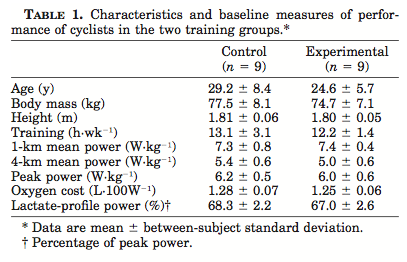
Twenty male cyclists with a minimum of 3 years of competitive experience volunteered for this study, which was approved by the institute’s ethics committee. After being informed of any risks associated with participation, each subject gave his written informed consent. The study was performed during the cyclists’ main competitive phase of the season after they had completed 3–5 months of sport-specific base and precompetition training. All cyclists were in a well-trained state and were competing in time trials and road-race cycling competitions at the highest domestic amateur level (New Zealand A grade) on at least 1 occasion per week for the duration of the study. A num- ber of the cyclists had represented New Zealand in international competition. None of the cyclists had participated in a traditional weights-based resistance-training pro- gram in the 6 months prior to the study. Two cyclists failed to complete the study: 1 moved out of the area and 1 had an accident during training. The characteristics and baseline exercise performance of the 18 cyclists who completed the study are shown in Table 1.
Exercise Performance Tests
All cyclists had participated previously in laboratory cycle-ergometer testing and were familiarized with the procedures prior to commencing the study. Cyclists reported to a temperature-control laboratory (20 C) on 2 occasions over a 4-day period to perform an incremental exercise test to determine peak power output, a 4-km time trial, a 2-stage submaximal test to determine oxygen consumption and lactate concentration, and a 1-km time trial. All tests were performed on the cyclist’s own road bicycle mounted to a wind-braked ergometer (Kingcycle Mk3, Kingcycle, High Wycombe, UK), which was calibrated in accordance with the manufacturer’s recommended procedures. An intermittent fault, which resulted in power output fluctuations of several percentage points, was noticed in the first few post tests. When this fault was diagnosed as a malfunctioning temperature sensor in the ergometer interface, we performed all subsequent tests on an older model Kingcycle ergometer (Mk1) without temperature correction.
Cyclists were instructed to refrain from hard physical activity for 24 hours and from eating for 3 hours prior to the performance trials.
Cyclists initially performed a 5-minute warm-up at a self-selected intensity followed by 5 minutes at a power of 100 W. Thereafter, power output was increased continuously at a rate of 33 W·min-1 until the cyclist reached volitional exhaustion. Peak power output was defined as the highest 60-second mean power output achieved during the test.
Twenty minutes after completing the peak power test, cyclists performed a maximal effort 4-km time trial to de- termine mean power output. The test commenced with a 2-minute countdown, during which the cyclists were required to maintain a constant power output of 50 W. Thereafter cyclists were required to complete the time trial as fast as possible. The only information available to the cyclists during the time trial was percentage distance remaining.
On the second day of testing and after completing the same warm-up procedure as previously described, cyclists completed a 2-stage submaximal test. Each stage lasted 5 minutes at power outputs equivalent to 60 and 80% of their pretest peak power. During the test, oxygen uptake was continuously measured with a calibrated metabolic cart (Vmax29, SensorMedics, Yorba, CA). Fingertip capillary blood was sampled during the last 15 seconds of each stage and was immediately assayed for whole blood lactate using an automated analyzer (YSI 1500 Sport, Yellow Springs, OH).
Two measures of performance were derived from the submaximal test. For each cyclist, the oxygen cost of exercise, expressed as liters of oxygen per 100 W, was calculated for the last minute of each of the 2 stages, then averaged. A measure representing the horizontal shift of the lactate profile was derived as follows. We assumed a log-log relationship between lactate concentration and power output (3). We used the growth function in Microsoft Excel to fit straight lines to the pre- and posttraining lactate plots and derived the percentage shift in the lactate profile using the mean of 5 equidistant segments for the overlapping lactate concentrations between tests. The pre-to-post change in this lactate profile represents the shift in the mean power and is analogous to change in 4- mM lactate-threshold power. We also derived the 4-mM lactate-threshold power from our data, but its error of measurement was substantially larger than that of the lactate-profile power.
Twenty minutes after completion of the submaximal test, cyclists performed a maximal effort 1-km time trial to determine mean power output. Procedures for this test were similar to those for the 4-km time trial.
Training
All cyclists were requested to keep a record of their weekly training and competition hours for the duration of the study. The control group was instructed to continue with their existing or planned training and competition program. The experimental group continued with their competition program, but replaced part of their usual training with twelve 30-minute sessions of a combination of explosive and high-resistance interval training sets. The experimental training was performed in a controlled laboratory environment under the supervision of a cycling coach. The training sessions were preceded and were followed by a 10-minute warm-up and cool-down at a self- selected intensity. Each session was performed 2–3 times per week, depending upon the cyclist’s availability, and consisted of 3 sets of maximal effort single-leg jumps alternating with 3 sets of maximal intensity cycling efforts. The jump phase of the training required subjects to perform 20 explosive step-ups off of a 40-cm box. The jump efforts were completed for the right and then left leg consecutively, repeated over a 2-minute period. The cycling phase required the cyclist to complete 5 ± 30 seconds maximal intensity cycling efforts at 60–70 min-1 with a 30-second rest between repetitions. A transition period of 2 minutes separated each cycle and jump set. The cycling sets were performed on racing bicycles (Giant Corporation, Taiwan) fitted with power-measuring cranksets (SRMpro, Schoberer-Rad-Messtechnik, Konigskamp, Germany) and attached to magnetically braked cycle ergometers (CS1000, Cateye, Osaka, Japan). The SRM cranksets were set to measure mean power every 2 seconds.
Statistical Analyses
Simple group statistics are shown as mean ± between subject SD. Mean effects of training and their 90% confidence limits were estimated with a spreadsheet (8) via the unequal-variances t statistic computed for change scores between pre- and posttests of the 2 groups. Each subject’s change score was expressed as a percentage of baseline score via analysis of log-transformed values, in order to reduce bias arising from nonuniformity of error. Errors of measurement and individual responses ex- pressed as coefficients of variation also were estimated with the spreadsheet. In addition, the spreadsheet com- putes chances that the true effects are substantial when a value for the smallest worthwhile change is entered. We used a value of 1% for the performance measures, because this represents the smallest worthwhile enhancement for cyclists competing in track and time-trial events (15). We also assumed 1% was the smallest worthwhile change in oxygen and lactate-profile power, because a 1% change in these measures would produce a 1% change in endurance performance in the absence of other factors affecting performance. We do not know how a change in body mass would affect cycling performance, so we chose 0.20 standardized units (change in mean divided by the between- subject SD in the pretest) as the smallest worthwhile change (5).
RESULTS
Training
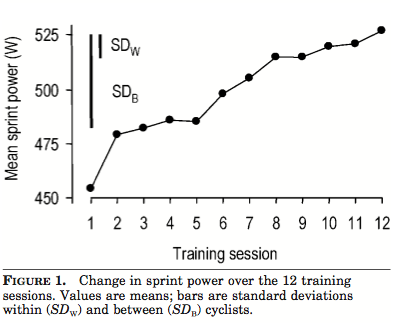
The time spent in training/competition during the exper- imental period of the study was 12.9 ± 3.3 h·wk-1 and 11.6 ± 2.1 h·wk-1 for the control and experimental groups, respectively. Figure 1 shows the time course of the change in mean 30-second power over each training session. There was a large (±5%) increase in mean 30- second power between the first 2 training sessions. Be- tween training sessions 2 and 12, there was a further 9% increase in 30-second power.
Effects on Performance
Table 2 shows the mean changes in the performance tests and physiological measures for experimental and control groups, and statistics for the difference in the changes. There were clear-cut beneficial effects on all measures of performance in the time trials and the incremental test. Effects on oxygen cost and lactate-profile power were beneficial, but less clear. The effect on body mass was trivial.
Standard deviations representing observed individual responses in performance were 1-km mean power, -1.3% (-3.5–3.1%); 4-km mean power, 2.5% (-4.6–6.0%); peak power, -2.7% (-5.2–3.8); lactate-profile power, 2.8% (-5.4–7.0%); and oxygen cost, -1.5% (-3.7–3.0). Any var- iation between individuals, represented by positive SD, was small relative to the mean effect of experimental training shown in Table 2. The uncertainty in both the positive and negative SD allows for, at most, modest in- dividual responses for all the measures, relative to the mean effects.
Observed SE of measurement for the experimental measures were 1-km mean power, 2.3%; 4-km mean pow- er, 3.3%; peak power, 3.4%; lactate-profile power, 3.9%; and oxygen cost, 2.4%. The 90% confidence limits for the true errors were X/div 1.55 for all measures.
DISCUSSION
The major finding in this study is that replacing part of normal competitive season training with 12 sessions of high-intensity interval and explosive resistance training produced major gains in laboratory measures of sprint and endurance performance in well-trained cyclists. In relation to the smallest estimated worthwhile effects, the large observed performance enhancements were almost certainly beneficial for cyclists and anecdotally extended to competitions.
Overall, the effect of the training intervention on peak power in our study (7%) is greater than that reported in other studies (2–6%; 2, 10, 16). Assuming that the un- certainty in the reported effects in previous studies is similar to our own (+/-3.6%) the difference in enhancement between our study and at least some of the previous studies is probably not due simply to sampling variation. A unique aspect of our study that could explain this superiority is the combination of the 2 different types of train-

ing that, when used individually, enhanced performance in previous studies. Several other aspects of our study could account for the greater performance enhancement. The dynamic sets were probably at a lower cadence and higher resistance, although we cannot be certain, because the training cadence was not reported in previous studies. The rest intervals between the individual repetitions (30 seconds) and between the sets (2 minutes) also were gen- erally shorter than those in previous studies (1–5 min- utes). Our study differed from previous studies in several other ways, but if anything, these differences would have reduced the performance enhancement. In particular, ours is the only study performed during the competitive season, when the cyclists were well trained already. The weekly training volume represented by the intervention (20% of the cyclists’ total weekly volume) also was lower than that of most other studies (30–40%).
Mean power in the training sprints increased by 14% over the duration of the study. Gains were rapid and occurred mainly in the first 8 sessions. Others have noted rapid gains in performance with high-intensity training (10). Our cyclists appeared to reach a plateau after the eighth session, but the plateau was not well defined, because the cyclists probably made a bigger effort in the last training session.
Individual responses to the training were small or negligible relative to the mean response for all measures of performance except lactate-profile power. The confidence limits for the individual responses represent considerable uncertainty in the estimates, but they allow for the possibility that the individual responses for all mea- sures were small. Considering that the training intervention for all cyclists was monitored closely and that all cyclists in the intervention achieved similar training volume and intensity, small individual responses were the expected outcome. The uncertainty in our estimates of individual responses would have been smaller if the SE of measurement of the performance tests had been less. It should be possible to achieve test-retest measurement errors of less than 2%, at least for direct measures of performance power (9). The failure of a temperature gauge on the ergometer (see the Methods section) and the switch to an earlier model ergometer are the likely reasons for the larger than expected error of measurement in our study. However, this larger error had little impact on our inferences for the mean effects, because the performance enhancements were so large.
In other studies of high-resistance training, the main and possibly only mechanism for the enhancement in endurance performance is a decrease in the oxygen cost (increase in economy) of exercise (6, 13, 14). In our study, the change in oxygen cost accounts for less than half the increase in power output. The change in oxygen cost also could account entirely for the change we observed in lactate-profile power, which was of similar magnitude. In studies where anaerobic threshold has been measured, the changes also could be attributed to changes in economy (10, 14). However, our uncertainty in the change in lactate-profile power was large, and at the upper confidence limit could account for most of the enhancement in endurance performance. If lactate-profile power does contribute to the performance enhancement over and above the decrease in oxygen cost, there would almost certainly have to be a corresponding increase in maximum oxygen uptake. Indeed, Laursen et al. (11) reported that high-intensity interval training led to substantial increases in maximum oxygen consumption in endurance cyclists. In studies that have used purely explosive-type training, changes in maximum oxygen consumption have been small or negligible (6, 14). We will need to measure maximum oxygen uptake and will need to use a more reliable protocol for lactate-profile power to resolve this issue.
Whereas changes in aerobic mechanisms may account for all or some of the increase in performance in the longer duration tests, they cannot account for all of the increase (9%) in the 1-km sprint, which has to be powered partly by anaerobic mechanisms. Adaptations in neural activation of muscle may have contributed to the increase in performance of our cyclists in the sprint. It is possible that the explosive resistance training we used led to increases in firing frequency of muscle motor units (1), thereby increasing muscle peak force and the rate of force development. Indeed, previous authors (2) have reported substantial increases in 30-second sprint power following a period of explosive resistance training.
PRACTICAL APPLICATIONS
The results of the present investigation show that combining explosive resistance with high-intensity interval training is a highly effective means of enhancing endurance and sprint performance in well-trained competitive cyclists. These enhancements appear to be due partly to increases in exercise efficiency and will presumably be of practical benefit in time trials and in road-race competitions where cyclists are required to complete numerous short-duration, high-intensity efforts (12). Further research is needed to investigate the relative contribution and optimization of the high-resistance and explosive sets to the gains in performance and to clarify the mechanisms responsible.
REFERENCES
BASTIAANS, J.J., A.B. VAN DIEMEN, T. VENEBERG, AND A.E. JEUKENDRUP. The effects of replacing a portion of endurance training by explosive strength training on performance in trained cyclists. Eur. J. Appl. Physiol. 86:79–84. 2001.
BEAVER, W., W. KARLMAN, AND B. WHIPP. Improved detection of lactate threshold during exercise using a log-log transfor- mation. J. Appl. Physiol. 59:1936–1940. 1985.
HOPKINS, W.G. Probabilities of clinical or practical signifi- cance. Sportscience [serial online]. 2002;6. Available from: http: //sportsci.org/jour/0201/wghprob.htm. Accessed August 2, 2005.
HOPKINS, W.G., E.J. SCHABORT, AND J.A. HAWLEY. Reliability of power in physical performance tests. Sports Med. 31:211– 234. 2001.
Acknowledgments
This research was conducted at the Waikato Institute of Technology, Hamilton, New Zealand.
Address correspondence to Carl D.Paton, carl.paton@ wintec.ac.nz.
+Author Affiliation
Centre for Phytochemistry and Pharmacology, Southern Cross University, Lismore, NSW 2480, Australia
Correspondence to:
C M Shing School of Human Movement Studies, The University of Queensland, St. Lucia, Brisbane, Qld 4072, Australia; cshing@hms.uq.edu.au
Purpose: The aim of this experiment was to investigate the influence of low dose bovine colostrum supplementation on exercise performance in cyclists over a 10 week period that included 5 days of high intensity training (HIT).
Methods: Over 7 days of preliminary testing, 29 highly trained male road cyclists completed a VO2max test (in which their ventilatory threshold was estimated), a time to fatigue test at 110% of ventilatory threshold, and a 40 km time trial (TT40). Cyclists were then assigned to either a supplement (n = 14, 10 g/day bovine colostrum protein concentrate (CPC)) or a placebo group (n = 15, 10 g/day whey protein) and resumed their normal training. Following 5 weeks of supplementation, the cyclists returned to the laboratory to complete a second series of performance testing (week 7). They then underwent five consecutive days of HIT (week 8) followed by a further series of performance tests (week 9).
Results: The influence of bovine CPC on TT40 performance during normal training was unclear (week 7: 1±3.1%, week 9: 0.1±2.1%; mean±90% confidence limits). However, at the end of the HIT period, bovine CPC supplementation, compared to the placebo, elicited a 1.9±2.2% improvement from baseline in TT40 performance and a 2.3±6.0% increase in time trial intensity (% VO2max), and maintained TT40 heart rate (2.5±3.7%). In addition, bovine CPC supplementation prevented a decrease in ventilatory threshold following the HIT period (4.6±4.6%).
Conclusion: Low dose bovine CPC supplementation elicited improvements in TT40performance during an HIT period and maintained ventilatory threshold following five consecutive days of HIT.
Robert P Lamberts, Michael I Lambert, Jeroen Swart, Timothy D Noakes
+Author Affiliations
UCT/MRC Research Unit for Exercise Science and Sports Medicine, Department of Human Biology, University of Cape Town, The Sport Science Institute of South Africa, Newlands, South Africa
Correspondence to
Dr Robert Patrick Lamberts, UCT/MRC Research Unit for Exercise Science and Sports Medicine, Department of Human Biology, Sport Science Institute of South Africa, University of Cape Town, PO Box 115, Newlands 7725, South Africa; RPLam@hotmail.com
Objective The purpose of this study was to determine if peak power output (PPO) adjusted for body mass0.32 is able to accurately predict 40-km time trial (40-km TT) performance.
Methods 45 trained male cyclists completed after familiarisation, a PPO test including respiratory gas analysis, and a 40-km TT. PPO, maximal oxygen consumption (VO2max) and 40-km TT time were measured. Relationships between 40-km TT performance and (I) absolute PPO  and VO2max (l/min), (II) relative PPO (W/kg) and VO2max (ml/min/kg) and (III) PPO and VO2max adjusted for body mass (W/kg0.32 and ml/min/kg0.32, respectively) were studied.
Results The continuous ramp protocol resulted in a similar relationship between PPO and VO2max (r=0.96, p<0.0001) compared with a stepwise testing protocol but was associated with a lower standard error of the estimated when predicting VO2max. PPO adjusted for body mass (W/kg0.32) had the strongest relationship with 40-km TT performance (s) (r=−0.96, p<0.0001). Although significant relationships were also found between absolute and/or relative PPO (W/kg) and 40-km TT performance (s), these relationships were significantly weaker than the relationship between 40-km TT performance and PPO adjusted for body mass (W/kg0.32) (p<0.0001).
Conclusions VO2max can be accurately predicted from PPO when using a continuous ramp protocol, possibly even more accurately than when using a stepwise testing protocol. 40-km TT performance (s) in trained cyclists can be predicted most accurately by PPO adjusted for body mass (W/kg0.32). As both VO2max and 40-km TT performance can be accurately predicted from a PPO test, this suggests that (well)-trained cyclists can possibly be monitored more frequently and with fewer tests.
Performance tests which measure a cyclist’s training status and are used to prescribe training have been used since the early 1900s.1,–,5 As maximal oxygen consumption (VO2max) is related to exercise capacity,6 VO2max has rapidly become the most popular measurement to determine training status in athletes, such as runners and cyclists.7,–,10 However, this parameter loses its accuracy to predict training status in a homogeneous group of well-trainedcyclists.11 12 In response, the measurement of peak power output (PPO) has gained popularity as a marker of training status.7 13 14 PPO can either be expressed as an absolute or relatively to body mass (W/kg), the latter being a predictor of a climbing capacity.7 In addition, a cyclist’s endurance capacity is normally tested by performing a laboratory-based time trial.14 The 40-km time trial (40-km TT) test has shown to be reliable12 15 and able to detect small meaningful changes in well-trained and elite cyclists.16,–,18
Although the performance parameters measured during these tests are valuable and potentially could assist in refining training programmes, these tests (VO2max, PPO and 40-km TT) are strenuous and are therefore not practical for monitoring purposes. As a consequence, these tests are normally only performed twice or three times per season.19 However, if one test could accurately predict other performance indicators, the volume of testing per session could decrease and possibly allow more frequent testing (monitoring). Accordingly, Hawley and Noakes11 developed a stepwise protocol and reported a strong relationship between PPO and VO2max (r=0.97), which allows the prediction of VO2max from PPO. In addition, Hawley and Noakes11 also reported a good relationship between PPO and 20-km TT time (r=−0.91) in a small group of male and female cyclists (n=19), suggesting that PPO can also predict endurance cycling capacity. However, when PPO within this study was expressed in relative terms, the relationship between PPO (W/kg) and 20-km TT performance became substantially weaker (r=−0.67). A similar finding was reported by Balmer et al20 who reported a strong relationship between absolute PPO and mean power measured during a 16.1-km flat time trial (r=0.99, n=16), but when 40-km TT time was compared with PPO, a significantly weaker relationship was found (r=−0.46). A possible explanation for these discrepancies could be that the effect of body mass was not considered appropriately when determining the relationships between PPO and time trial performance.
In support of this, Swain has shown that body mass is an advantage when performing a flat time trial and is a disadvantage for climbing cycling capacity.21 22 Based on these findings, Swain has suggested that body mass should be adjusted to the power of 0.32 when predicting flat time trial performance.21 22 Subsequently, Mujika and Padilla9 have used this allometric scaling method profiling 24 professional road cyclists. This study showed that PPO adjusted for body mass (W/kg0.32) was the strongest predictor of time trial specialists, which supports Swain’s allometric scaling method to predicting endurance cycling capacity.
Although this method has the potential to predict endurance cycling capacity, to our knowledge no study has confirmed the accuracy of this method in a large group of trained cyclists. Therefore, the aim of this study was to determine whether PPO or VO2max adjusted for body mass (W/kg0.32, ml/min/kg0.32, respectively) is able to more accurately predict 40-km TT performance than absolute PPO or VO2max (l/min) or relative PPO (W/kg) or VO2max(ml/min/kg). A secondary aim was to confirm whether VO2max can also be accurately predicted from PPO when using a continuous ramp protocol.
Forty-five competitive male cyclists of varying training status were recruited for this study. Subjects had a competitive cycling history of 8±5 years, ranging from 2 to 21 years, and trained on average 10±3 h per week, ranging from 5 to 20 h per week. Prior to participation, all cyclistscompleted a Physical Activity Readiness Questionnaire (PAR-Q)23 and signed a written informed consent. Ethical approval for the study was provided by the Research and Ethics Committee of the Faculty of Health Sciences of the University of Cape Town. The principles of the World Medical Association Declaration of Helsinki and the American College of Sports Medicine Guidelines for Use of Human Subjects were adopted in this study.24
In the 2 weeks before the performance tests, all subjects completed a PPO test, including gas analysis, and the 40-km TT test for familiarisation purposes. Subjects were asked to refrain from eating for 2 h before the test and from drinking any caffeine 3 h before the test. Measurements including height, weight and seven skinfolds (triceps, biceps, supra-iliac, subscapular, calf, thigh and abdomen)25 were performed at the start of the study while body fat percentage was calculated.26 All tests were performed on Computrainer cycle ergometers (Computrainer Pro 3D; RacerMate, Seattle, Washington, USA), which were calibrated before each test as recommended and described previously.12 The 40-km TT test was performed 72 h after the PPO test. All performance tests were conducted under stable environmental laboratory conditions (21.9±1.0°C, 51±4% relative humidity, 102.1±0.7 kPa).
The PPO test, which included respiratory gas analysis, was started 8 min after a standardised warm-up period, known as the Lamberts and Lambert Submaximal Cycle Test (LSCT).12 19The starting work rate of the PPO test was set at 2.50 W/kg and was thereafter increased continuously at a rate of 20 W/min.12 The end of the PPO test was defined as the point where the cyclist could no longer maintain a cadence higher than 70 revolutions per min (rpm). The online breath-by-breath gas analyzer (Oxycon pro, Viasis, Hoechberg, Germany), which has been shown to be valid and accurate,27 was warmed-up and calibrated as prescribed by the manufacturer. Data were collected over 15-s intervals, while VO2max was determined as the highest recorded reading for 30 s. PPO was determined as the mean power output during the final minute of the PPO test. PPO and VO2max adjusted for body mass to the power of 0.32 were expressed as PPO0.32 (W/kg0.32) and VO2max0.32 (ml/min/kg0.32), respectively. For example, a subject who weighs 70 kg and has a PPO of 350 W has a relative power of 350/70 = 5.0 W/kg and a PPO0.32 of 350/700.32 = 89.9 W/kg0.32.
The 40-km time trial (40-km TT test) was performed on a simulated 40-km flat time trial course, which was created on the Computrainer system and was started 3 min after a standardised warm-up period (LSCT).12 19 Subjects were allowed to drink water ad libitum and were asked to complete the distance as fast as possible. In an attempt to control for any pacing strategies, the subjects were only given their completed distance and were not given any feedback about other aspects of their performance, such as power output, time or speed. No verbal encouragement was given during the time trial, except for the last kilometre when the distance was counted down in 100-m sections and during the last 100 m in 10-m sections.
Power output, speed, cadence and elapsed time were measured and stored by the Computrainer software at a rate of 34 Hz. Heart rate data during these tests were captured continuously with Suunto T6 heart rate monitors (Suunto Oy, Vantaa, Finland) and calculated into 2-s averages. Analysis of performance data was performed using CyclingPeaks analysis software (WKO+ edition, Version 2.1, 2006, Lafayette, Colorado, USA) and the Computrainer coaching Software (Version 1.5.308; RacerMate). Heart rate data were analysed with Suunto Training Manager (Version 2.1.0.3; Suunto Oy).
Statistical analysis was performed using STATISTICA version 10.0 (Stat-soft, Tulsa, Oklahoma, USA). All data are expressed as mean±SD. Relationships between PPO and VO2max and 40-km TT were assessed with Pearson’s product–moment correlation (GraphPad Prism version 5.02 for Windows, GraphPad Software, San Diego, California, USA). In addition, 95% CI were calculated for all relationships. Statistical differences between the slopes of relationships were analysed with the use of Graphpad software.
The general characteristics and performance parameters of the 45 trained cyclists are shown in table 1.
Descriptive and performance data of the 45 trained cyclists
The relationships between absolute PPO and absolute VO2max (l/min) and relative PPO (W/kg) and relative VO2max (ml/min/kg) are shown in figure 1. Significant relationships were found between absolute PPO and VO2max (r=0.96 (95% CI 0.93 to 0.98), p<0.0001) and relative PPO and VO2max (r=0.94 (95% CI 0.89 to 0.97), p<0.0001).

The relationship between absolute peak power output (PPO) and absolute VO2max (A) and relative PPO and relative VO2max (B).
Both relationships between PPO and VO2max were linear and are characterised by the following regression equations:

The SEE of VO2max (l/min) from PPO is 0.15 l/min.

The SEE of VO2max (ml/min/kg) from PPO (W/kg) is 2.16 ml/min/kg.
The relationships between VO2max adjusted for body mass (ml/min/kg0.32) and 40-km TT performance expressed as time or as mean power (PO) are shown in figure 2A,B, respectively. Significant relationships were found between both VO2max0.32 and 40-km TT time (r=−0.93 (95% CI −0.88 to −0.96), p<0.0001) and VO2max0.32 and average 40-km TT PO (r=0.93 (95% CI 0.88 to 0.96), p<0.0001).

The relationship between adjusted relative VO2max (ml/min/kg0.32) and 40-km time trial (40-km TT) time (A) and mean power output during the 40-km TT (B).
The relationship between VO2max0.32 and 40-km TT time and mean 40-km TT PO were characterised by the following regression equations:

The SEE of 40-km TT time (s) from VO2max0.32 is 70 s.

The SEE of mean 40-km PO from VO2max0.32 is 12 W.
In figure 3A,B, the relationships between PPO adjusted for body mass (W/kg0.32) and 40-km TT time and mean 40-km TT PO are shown. Even stronger relationships were found between the relative PPO0.32 and 40-km TT time (r=−0.96, 95% CI −0.93 to −0.98, p<0.0001) and average 40-km TT power (r=0.92, 95% CI 0.86 to 0.96, p<0.0001).

The relationship between adjusted relative peak power output (PPO) (W/kg0.32) and 40-km time trial (40-km TT) time (A) and mean power output during the 40-km TT (B), relative PPO (W/kg) and 40-km TT time (C) and mean power output during the 40-km TT (D) and, absolute PPO and 40-km TT time (E) and mean power output during the 40-km TT (F).
The relationships between PPO0.32 and 40-km TT time and mean PO were characterised by the following regression equations:

The SEE of 40-km TT time (s) from PPO0.32 is 52 s.

The SEE of mean 40-km Power from VO2max0.32 is 12 W.
Significant differences in slope (p<0.01) showed that PPO0.32 is able to predict 40-km TT performance more accurately than VO2max0.32. In addition to PPO0.32, the relationships between 40-km TT performance and absolute and relative PPO were also determined (figure 3C–F). Significant relationship were found between absolute PPO and 40-km TT performance (time: r=–0.90, 95% CI –0.83 to –0.95, p<0.0001, SEE: 81 s; mean power: r=0.90, 95% CI 0.83 to 0.95, p<0.0001, SEE: 14 W) (figure 3E,F) and, also relative PPO (W/kg) and 40-km TT performance (time: r=–0.70, 95% CI –0.51 to –0.82, p<0.0001, SEE: 131 s; mean power: r=0.58, 95% CI 0.35 to 0.75, p<0.0001, SEE: 26 W) (figure 3C,D). However, significant differences in slope revealed that the relationships between 40-km TT performance and absolute and relative PPO (both p<0.001), were weaker than the relationship between 40-km TT performance and PPO0.32.
The first important finding of this study was the strong relationship between PPO and VO2maxeither expressed in absolute (r=0.96 (l/min)) or relative (r=0.94 (ml/min/kg)) terms. These findings are similar to the findings by Hawley and Noakes,11 who used a stepwise testing protocol instead of a continuous ramp protocol and reported a significant relationship between absolute PPO and VO2max of r=0.97 (l/min). Although the regression equations are different, this finding confirms that VO2max can be predicted from PPO determined by both a stepwise and/or continuous ramp protocol. As the standard error of estimate (SEE) of the predicted VO2max in the current study (SEE 3%) is lower than the SEE in the study of Hawley and Noakes (SEE 6%), this finding suggests that PPO measured by a continuous ramp is slightly more reliable and able to predict VO2max more accurately. However, other factors such as a different sample population or improved/new equipment for measuring PPO and/or VO2max more accurately could also explain this finding.
The main finding of this study was that both VO2max0.32 and PPO0.32 are able to accurately predict 40-km TT performance (r=−0.93 and r=−0.96, respectively). The strongest relationship and the lowest SEE when predicting 40-km TT performance was found when PPO was adjusted for body mass (W/kg0.32) (r=−0.96, SEE: 52 s). This finding supports the allometric scaling method proposed by Swain.21 In addition, Swain reported a strong relationship between 40-km TT time and 40-km TT PO (r=−0.94),21 suggesting that both 40-km TT time and PO should be accurately predicted from PPO0.32. This is similar to our findings, which show a strong relationship between PPO and both 40-km TT time (r=−0.96, 95% CI −0.93 to −0.98, p<0.0001) and 40-km TT PO (r=0.93, 95% CI 0.86 to 0.96, p<0.0001). The finding by Muijka and Padilla,9who reported that PPO0.32 was the strongest predictor of time trial specialists, also support the proposed allometric scaling method of Swain to predict flat time trial performance. However, the current study is the first study to compare the relationships between 40-km TT performance and absolute PPO (W), relative PPO (W/kg) and PPO0.32 (W/kg0.32). As PPO0.32 (W/kg0.32) had a significantly better relationship with 40-km TT performance than absolute and relative PPO (both p<0.001), the allometric scaling method is able to more accurately predict flat 40-km TT performance in a heterogeneous group of trained cyclists.
As the current study only shows that PPO0.32 is able to predict flat 40-km TT performance performed on a cycle ergometer, future research studies need to determine the capacity of PPO0.32 to predict outdoor 40-km TT performance, as also suggested by Nevill et al.28However, as the main aim of 40-km TTs is to determine and monitor changes in the endurance cycling capacity, PPO0.32 seems to be the most accurate prediction method. As we have conducted our research on a fairly heterogeneous group of trained cyclists (coefficient of variation for VO2max was 11%), it is not known if the relationship between PPO0.32 and 40-km TT is similar in a homogeneous group of elite cyclists, particularly since with this group other factors like cycling efficiency might also contribute to endurance cycling capacity.
Previous research has shown that there is a relationship between peak power output (PPO) and time trial performance. However, these findings seem to be inconclusive and vary when time trial performance is expressed in different units (eg, time or mean power). A possible explanation can be that the advantage of body mass is not correctly considered when determining the relationship between PPO and time trial performance. It has been suggested that PPO and maximal oxygen consumption (VO2max) should be adjusted for body mass to the power of 0.32 to accurately predict flat time trial performance.
This study shows that PPO adjusted for body mass to the power of 0.32 (W/kg0.32) predicts 40-km time trial performance more accurately than absolute or relative PPO (W/kg). In addition both absolute and relative PPO were able to predict VO2max, suggesting that a single PPO test can potentially be used to determine a cyclist’s peak and endurance cycling capacity. As a PPO test is relatively easy to conduct (minimal amount of equipment and limited side effects on normal training and racing habits), the current established relationships possibly allow a more regular monitoring programme for well-trained and elitecyclists in addition to submaximal monitoring programmes.
In conclusion, the findings of this study show that in addition to PPO, both 40-km TT performance and VO2max can be accurately predicted from a single PPO test. This suggests that the number of tests needed to determine a cyclist’s cycling capacity (peak and endurance) can possibly be reduced to a PPO test. In addition, minimal equipment is needed to perform a PPO, the duration of a PPO test is short (in most cases ranging from 8 to 12 min) and a cyclist recovers relatively quickly from a PPO test (in comparison to a TT). Collectively, this suggests that a 20 W/min continuous ramp PPO protocol can be used more frequently to monitor changes in PPO, VO2maxand 40-km TT performance in (well)-trained and elite cyclists. However, it seems unlikely that it can fully replace submaximal cycle tests, such as the LSCT which can be performed on a weekly basis in elite cyclists.19 29
In summary, this study shows that PPO0.32 (W/kg0.32) is able to predict laboratory 40-km TT performance/endurance capacity in trained cyclists more accurately than absolute PPO and/or relative PPO (W/kg). In addition, PPO (absolute and relative) determined during the same continuous ramp protocol PPO test, is able to accurately predict VO2max. These findings suggest that in addition to PPO, both VO2max and endurance cycling capacity can be predicted from a single PPO test.
The authors would like to thank all cyclists who participated in this study.
Funding This study was funded by the RA Noakes Fellowship, Medical Research Council of South Africa, Discovery Health and the University of Cape Town.
Competing interests None.
Ethics approval This study was conducted with the approval provided by the Research and Ethics Committee of the Faculty of Health Sciences of the University of Cape Town.
Provenance and peer review Not commissioned; externally peer reviewed.
. Der Gasstoffwechsel als mab der körperlichen Leistungsfähigkeit. Dtsch Arch Klin Med 1928;17:367–71.
. Über das Minutenvolumen des Herzen bei Ruhe und bei Muskelarbeit.Pflugers Arch 1915;161:233–83.
Ergometric and psychological findings during overtraining: a long-term follow-up study in endurance athletes. Int J Sports Med1998;19:114–20.
. Muscular exercise, lactic acid and the supply and utilization of oxygen: parts I–III. Proc R Soc 1924;96:438–75.
. Muscular exercise, lactic acid, and the supply and utilization of oxygen. Q J Med 1923;16:135–71.
The relation between power output, oxygen uptake and heart rate in male athletes. Int J Sports Med 1994;15:228–31.
The bioenergetics of World Class Cycling. J Sci Med Sport 2000;3:414–33.
. High-Performance Cycling. Champaign, IL: Human Kinetics Publishers2002.
Physiological and performance characteristics of male professional road cyclists. Sports Med 2001;31:479–87.
Characteristics of track cycling. Sports Med 2001;31:457–68.
Peak power output predicts maximal oxygen uptake and performance time in trained cyclists. Eur J Appl Physiol Occup Physiol 1992;65:79–83.
Measurement error associated with performance testing in well-trained cyclists: application to the precision of monitoring changes in training status. Int SportMed J 2009;10:33–44.
Heart rate and performance parameters in elitecyclists: a longitudinal study. Med Sci Sports Exerc 2000;32:1777–82.
The science of cycling: physiology and training – part 1.Sports Med 2005;35:285–312.
Assessment of the reproducibility of performance testing on an air-braked cycle ergometer. Int J Sports Med 1996;17:293–8.
Improved athletic performance in highly trained cyclists after interval training. Med Sci Sports Exerc 1996;28:1427–34.
Effects of different interval-training programs on cycling time-trial performance. Med Sci Sports Exerc 1999;31:736–41.
Changes in heart rate recovery after high-intensity training in well-trained cyclists. Eur J Appl Physiol 2009;105:705–13.
A novel submaximal cycle test to monitor fatigue and predict cycling performance. Br J Sports Med 2011;45:797–804.
Peak power predicts performance power during an outdoor 16.1-km cycling time trial. Med Sci Sports Exerc 2000;32:1485–90.
The influence of body mass in endurance bicycling. Med Sci Sports Exerc1994;26:58–63.
Influence of body size on oxygen consumption during bicycling. J Appl Physiol 1987;62:668–72.
American College of Sports Medicine. Submaximal exercise tests. In: Whaley MH, Brubaker PH, Otto RM eds. ACSM’s Guidelines for Exercise Testing and Prescription. Baltimore, MD: Lippincott Williams & Wilkins 2007:70–4.
. Kinanthropometry.In: MacDougall JD, Wenger HA, Green HS, eds. Physiological Testing of the High Performance Athlete. Champaign, IL: Human Kinetics 1991:223–308.
Body fat assessed from total body density and its estimation from skinfold thickness: measurements on 481 men and women aged from 16 to 72 years.Br J Nutr 1974;32:77–97.
Validation of a computerized metabolic measurement system (Oxycon-Pro) during low and high intensity exercise. Int J Sports Med 2001;22:291–4.
Scaling maximal oxygen uptake to predict cycling time-trial performance in the field: a non-linear approach. Eur J Appl Physiol2005;94:705–10.
Measuring submaximal performance parameters to monitor fatigue and predict cycling performance: a case study of a world-class cyclo-cross cy
Interesting article regarding the power output of Rodriguez, Contador, Valverde & Froome from this years Vuelta. It’s in French but the numbers aren’t. Each climb is individually listed out with the power to weight ratios and note that their are plenty or assumptions.
http://www.cyclisme-dopage.com/puissances/2012-09-10-cyclisme-dopage.htm
Eur J Appl Physiol (2011) 111:2885–2893 DOI 10.1007/s00421-011-1914-3
ORIGINAL ARTICLE
The relationship between cadence, pedalling technique and gross efficiency in cycling
Stig Leirdal · Gertjan Ettema
Received: 20 October 2010 / Accepted: 7 March 2011 / Published online: 25 March 2011 © The Author(s) 2011. This article is published with open access at Springerlink.com
Abstract Technique and energy saving are two variables often considered as important for performance in cycling and related to each other. Theoretically, excellent pedalling technique should give high gross efficiency (GE). The pur- pose of the present study was to examine the relationship between pedalling technique and GE. 10 well-trained cyclists were measured for GE, force effectiveness (FE) and dead centre size (DC) at a work rate corresponding to »75% of VO2max during level and inclined cycling, seat adjusted forward and backward, at three different cadences around their own freely chosen cadence (FCC) on an ergometer. Within subjects, FE, DC and GE decreased as cadence increased (p < 0.001). A strong relationship between FE and GE was found, which was to great extent explained by FCC. The relationship between cadence and both FE and GE, within and between subjects, was very similar, irrespective of FCC. There was no difference between level and inclined cycling position. The seat adjustments did not affect FE, DC and GE or the relation- ship between them. Energy expenditure is strongly coupled to cadence, but force effectiveness, as a measure for pedalling technique, is not likely the cause of this relationship. FE, DC and GE are not affected by body orientation or seat adjustments, indicating that these parameters and the relationship between them are robust to coordinative challenges within a range of cadence, body orientation and seat position that is used in regular cycling.
Communicated by Jean-René Lacour.
S. Leirdal (&) · G. Ettema
Department of Human Movement Science,
Norwegian University of Science and Technology (NTNU), Dragvoll Idrettssenter 3 etg, 7491 Trondheim, Norway e-mail: stig.leirdal@svt.ntnu.no
Keywords Cadence · Inclined · Level · Pedalling · Technique
Introduction
In cycling, not only the work capacity but also a proper technical execution of the propulsive movements is often considered to be important for performance. In cycling, force effectiveness (FE) is often used as a parameter to indicate the quality of pedalling technique (e.g., Patterson and Pearson 1983; Ericson and Nisell 1988; Coyle et al. 1991; Sanderson 1991; Sanderson and Black 2003; Zameziati et al. 2006; Candotti et al. 2007; KorV et al. 2007). FE is the ratio between the force directed 90° on the crank arm and the total resultant force on the pedal. Furthermore, it is generally believed that high gross efficiency (GE) is related to good technique in general and high FE speciffically (e.g., Zameziati et al. 2006; Candotti et al. 2007). In a mechanically effective pedalling technique with high FE a large component of the generated force is directed perpendicu- larly on the crank arm. Forces directed otherwise, i.e., radially to the crank, do not contribute to work rate and the associated energy cost is wasted. Thus, in principle, FE affects GE in a direct manner. A number of studies have demon- strated a moderate to strong relationship between FE and GE (e.g., Zameziati et al. 2006; Candotti et al. 2007).
On the other hand, various studies have shown that for an effective and powerful crank cycle, one must generate considerable radial forces. This is due to the mechanical constraints within the rider–bicycle system (Kautz and Hull 1993). Because of the constraints, it is not a priori so that the most effective force is generated with the least muscular effort. Furthermore, inertial and gravitational forces add to the ineffective component of pedal forces (Kautz and Hull 1993), which are of no physiological consequence. This raises questions on both the origin as well as the signifcance of the apparent relationship between FE and GE.
GE indicates the total metabolic rate, including muscle work rate, for a given external work rate, and FE is the resultant outcome of all muscle activation. Thus, an FE–GE relationship that is unaffected by other factors would indi- cate that the total amount of muscle work done at a given external work rate (via GE) and the net coordinative out- come (via FE) are tightly coupled.
Cadence is shown to affect both FE (Patterson and Pear- son 1983; Sanderson 1991; Candotti et al. 2007; Lorås et al. 2009) and GE (Seabury et al. 1977; Coast and Welch 1985; Belli and Hintzy 2002; Foss and Hallen 2004, 2005; Sam- ozino et al. 2006; Hansen and Sjøgaard 2007). Body orientation (e.g., inclination as in inclined cycling) and seating position (e.g., differences between road cycling, time trial and triathlon cycling, see Faria et al. 2005) are factors that possibly affect both FE and/or GE (e.g., Bertucci et al. 2005; Brown et al. 1996; Caldwell et al. 1998, 1999; Millet et al. 2002; Faria et al. 2005; Heil et al. 1997; Price and Donne 1997; Ricard et al. 2006; Umberger et al. 1998; Welbergen and Clijsen 1990). While both FE and GE are studied quite extensively related to these factors, relatively little is done on the relationship between FE and GE, i.e., if the relationship is independent of other factors. Particularly, the role of cadence is of importance and may explain any relationship between FE and GE if it affects both in a similar fashion.
Recently, Leirdal and Ettema (2010) introduced a new pedalling technique parameter, which described the dead centre (DC) and was deffined as the minimum power divided by the average power during the pedal stroke. It had a stronger relationship with GE than FE and it was, unlike FE, not affected by inertial forces that increase with cadence. Thus, it could be hypothesised that DC is not affected by cadence in the way that FE and GE are. The influence of cadence on DC has not been investigated before. By studying, in detail, how the relationship between on the one hand FE and DC (technique) and on the other GE (energy expenditure) is affected by cadence, more insight may be obtained in how cycling technique and energy expenditure are related.
In the present study, we therefore investigated the relationship between pedalling technique (FE and DC) and GE, over three cadences, for level and inclined cycling position, and for three seating positions. We took the freely chosen cadence (FCC) of the cyclists as a departure point to set the range of cadences. This increased the total range of cadences and allowed for studying the effect of absolute (inter-individual differences) as well as relative cadence (intra-individual differences).
Method
Subjects
The study was approved by the local ethics committee and all participants signed an informed written consent before participating in the study. Ten well-trained cyclists, at a national and regional level, participated in the study. The participant’ s physical characteristics are presented in Table 1.
Protocol and analysis
All participants met in the lab on two occasions. On the first occasion, they performed an incremental test at freely chosen cadence (FCC) on a Velotron ergometer with a computer-controlled electro-magnetic brake mechanism (Velotron, Racermate inc., Washington). This ergometer generates a constant power condition, independent of cadence. The participants wore cycling shoes and the seat and handle bar position on the ergometer was adjusted to the preferred sitting position for each participant. During the test, the participants did not receive any information about their pedal rate. After a 10-min warm-up at 100 W, the participants performed an increasing work rate protocol that started at 100 W and had a 50 W increment every 2 min until exhaustion. Exhaustion was defined as meeting three of the four following criteria: (1) within 5 BPM from the participants self-reported maximal heart rate (HRmax), (2) above 7.5 mmol l¡1 in blood lactate concentration, (3) the respiratory exchange ratio (RER) >1.1, and (4) a VO2 which stops increasing or starts decreasing with increased work rate. Pedal rate, oxygen consumption, and heart rate were measured continuously.
Gas exchange values were measured by open-circuit indirect calorimetry using an Oxycon Pro apparatus (Jaeger GmbH, Hoechberg, Germany). Before each measurement, the VO2 and VCO2 gas analyzers were calibrated using high-precision gases (16.00 § 0.04% O2 and 5.00 § 0.1% CO2, Riessner-Gase GmbH & co, Lichtenfels, Germany). The flow meter was calibrated with a 3-L volume syringe (Hans Rudolph Inc., Kansas City, MO). Heart rate (HR) was measured with a heart rate monitor (Polar S610, Polar Electro OY, Kempele, Finland), using a 5-s interval for data storage. VO2max was defined as the highest 1-min
Table 1 Physical characteristics of the participants in study
Age (years): Avg 23.4 Std 11.7
Height Body (cm) mass (kg): 183.2, 77.3: std 6.3, 9.5
VO2peak Maximal (ml kg min¡1) aerobic power (watt): 58.1, 370: std 3.3, 42
average VO2 during the test. Maximal heart rate was defined as the highest value that was attained, in average over a 5-s period at the final stage of the protocol. Blood lactate concentration was measured 2 min after completion of the VO2max test (10.6 mmol l¡1 § 1.9) by taking 5 uL samples from the fingertip by a Lactate Pro LT-1710t (ArkRay Inc, Kyoto, Japan). This system was validated in literature (Medbø et al. 2000; Pyne et al. 2000; Baldari et al. 2009).
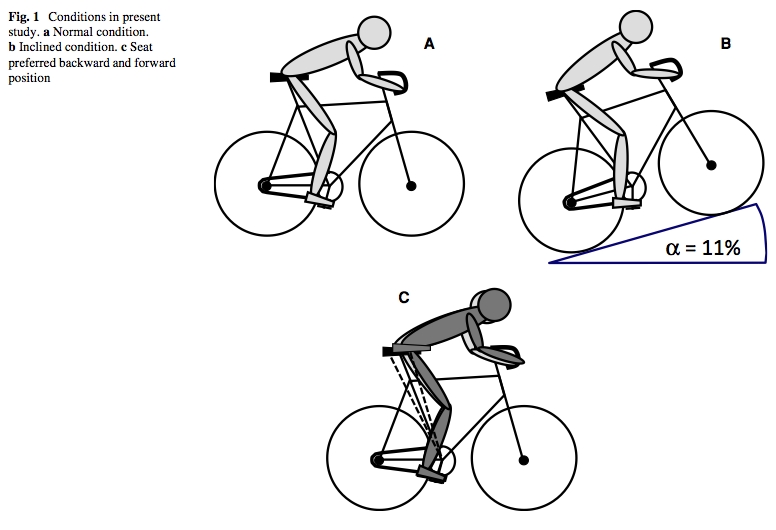
The second occasion, 3 days after the incremental test, all participants performed a protocol consisting of eight repetitions of 5 min cycling at a work rate that was estimated to elicit »80% of their VO2max as was determined in the first test. Also during this test, the participants wore cycling shoes. The efforts were done at level and in tilted (11%, i.e., 6.3° inclined) position (Fig. 1b), all at preferred seat position. In the tilted position, the entire ergometer was tilted by elevating the front. Both positions (level and tilted) were performed at three cadences (FCC, FCC ¡ 10 and FCC + 10 rpm), giving six conditions. In addition, the level position was also performed with the seat moved forward and backward from the preferred position, giving two additional conditions. Corresponding seat adjustments were made in height as well, such that the angle of the line between crank centre and (rock point of the) seat was rotated by approximately 3° in both directions. This led to a similar total angle change of about 6° as in levels versus inclined position. For all forward and backward positions the distance between hip (major trochanter) and crank centre was unaltered in comparison with preferred seat position (Fig. 1c). This was done using a tape measure. The handle- bars were moved in the same manner. Thus, in these conditions, the orientation of the upper body was not altered.
During all tests on the second occasion, the participants received continuous feedback about their cadence and were asked to keep it at a preset level. The FCC was set as the average cadence that was used the last minute during the incremental test at the work rate increment nearest 80% of VO2max. To avoid any effect of fatigue, learning effect, or drift of energy expenditure in the statistical analysis, all conditions were done in a different order for each partici- pant. Oxygen consumption and heart rate were measured continuously. GE was calculated as the ratio of work rate over metabolic cost rate as calculated from VO2 and RER. All measurements on »80% VO2max showed RER values below 1.0 (RER was 0.89 § 0.03) indicating no significant anaerobic contribution. Kinetics was sampled for 5 times for 10 s at the end of each minute during the 5-min work periods.

Crank and pedal kinematics were recorded using a Pro- ReXex (Qualisys, Sweden) 3D motion capture system with 8 cameras in the same way as described by Ettema et al. (2009). Two spherical reflective markers were placed on extensions of both pedals in the sagittal plane of cyclist and bicycle. The positions of these markers were used to deter-mine pedal orientation and crank angle. Both pedals were equipped with two force cells (Model 9363, Revere, capacity 250 kg per cell, The Netherlands), detecting pedal normal and shear forces (Ettema et al. 2009). The pedals were calibrated by applying full normal forces and full shear forces of known magnitude. A constant proportional cross- talk between the normal and shear forces of a single pedal was detected (<3%) and taken into account by building a gain matrix.
All data were recorded using the QTM software (Quali- sys, Sweden) at a sample rate of 500 Hz and further processed in Matlab (Mathworks, US). All data were low- pass Wltered (10 Hz, 8th order, zero lag Butterworth). After correction for acceleration artefacts (Ettema and Huijing 1994), pedal normal and shear forces were transformed to crank shear and normal forces by rotation of the coordination system from pedal to crank using the angle between pedal and crank as calculated from the kinematical data. The vector sum of right and left pedal forces (in the crank coordinate system) was used for further analysis (Lorås et al. 2009). This leads to higher FE values than considering the pedals separately, mainly because of the elimination of the negative effect of gravity during the up-stroke.
Normal crank force was considered to be the effective force component. Thus, the ratio of normal force over total force was defined as FE. FE was calculated as average of the 5 & 10 s measurements from each 5-min work period.
DC was defined as the lowest work rate (average of top and bottom dead centre) divided by the average work rate (Leirdal and Ettema 2010). Thus, this is a parameter describing the evenness of work rate generation; 100% indicates a perfect circular work rate generation, whereas 0% indicates that the work rate at the DC equals zero.
Power was calculated as the product of crank moment (i.e., effective (normal) crank force & crank arm) and crank angular velocity. Continuous crank angular velocity was calculated from crank angles using a 5-point differentiating filter. The average crank cycle (for all variables) was calculated by interpolation of the crank angle—variable data to 360 samples, i.e., 1 sample per degree crank angle (Ettema et al. 2009).

To investigate how technique (FE, DC) and effciency of energy consumption (GE) relate to each other, and how cadence may affect this relationship, we performed correlation matrix analysis as well as multiple regression analysis for GE with FE, DC, FCC and work rate as independent variables.
Statistics
All statistics were performed using Statistical Package for Social Sciences 15.0 (SPSS). The analysis consisted of two parts. Firstly, to confirm or refute findings in the literature, the general effect of cadence (in the range of 20 rpm around FCC) and position on the variables of interest was examined: the intra-individual effects of position and cadence on GE, FE, and DC was analysed using a 2-way ANOVA (cadence and body position) and a 1-way ANOVA (seat position). FCC and absolute work rate were implemented as covariates. The second and main part of the analysis regarded the effect of cadence on the relationship between technique and energy expenditure: the inter-individual relationships between GE (dependent) and FE, DC, FCC, and work rate (independent variables) was performed by multiple regression analysis at the three cadences. Furthermore, Pearson’ s correlations between variables were compared. This approach could not only indicate if, but also how FE and GE are related. Normality of the data distribution was checked with the one-sample Kolmogorov–Smirnov test. All data were considered normally distributed (all p values >0.337). The signifcance level was set at p < 0.05.
Results
The FCC in the main experiment (at the predicted work rate of 80% VO2max, averaging 210 W) was 96 § 9.1 rpm (range 75–107). Thus, the FCC ¡ 10 and FCC + 10 conditions were performed on 86 § 9.1 and 106 § 9.1 rpm, respectively. The load in this test elicited 75% VO2max instead of the predicted 80% during the steady-state cycling.
The 2-way ANOVA showed the following results for GE, FE and DC (average results are presented in Fig. 2). GE, FE and DC declined significantly (p < 0.001) with each increase in cadence in a similar way. Body orientation did not seem to have any effect on either FE (p = 0.307), GE (p = 0.823) or DC (p = 0.166). Seat position had no effect on GE (p = 0.58) or DC (p = 0.978). The effect on FE was just not significant (p = 0.058). No significant cadence–orientation interaction was detected (FE, p = 0.090; GE, p = 0.794; and DC, p = 0.382). The weak interaction trend for FE was localized between FCC and FCC + 10, which was different between the level and inclined orientation (p = 0.036). Both work rate (mean 210 W, §40 W) and FCC differed between participants in present study. Absolute work rate affects GE (Leirdal and Ettema 2009) and possibly FE and DC directly as well as being dependent on cadence. Therefore, we also treated absolute work rate and FCC as a covariate and examined its effect. The statistical findings using work rate as a covariate remained unaltered except for DC: cadence on FE, p = 0.001; on DC, p = 0.164;on GE, p = 0.027; orientation on FE, p = 0.553; on GE, p = 0.172; interaction on FE, p = 0.981; on DC, p = 0.424; on GE, p = 0.708. Thus, the weak interaction trend on FE is explained by work rate differences. When using FCC as a covariate, all significant effects on FE, DC and GE disappeared (all p > 0.175). In summary, within a subject, cadence was the main variable influencing FE, DC and GE in a similar way. Yet, these effects seemed to be related to the subject’s FCC such that cyclists with a high FCC tend to show a cadence effect and those with low FCC did not.
Body orientation and seating position did not seem to have any effect on any of FE, DC, and GE. We double checked this by comparing the regression lines for the various conditions with the line of identity. In all cases, the regression estimate for FE, DC, and GE between any of the comparable conditions (4 at FCC, 2 at each other cadence) did not significantly differ from the line of identity (i.e., the intercept = 0 and slope = 1).
Thus, we could reduce the data by comparing the mean data for all conditions at each cadence. Table 2 shows a correlation matrix of all variables of interest. It appears that over the three cadences, inter-individual differences in FE and GE, and to a lesser extent also DC, are very consistent. FCC is strongly cor- related with FE at all cadences, but not with DC. DC and FE are not related. Work rate correlates well with FCC, FE and GE. In the multiple regression analysis, for all three cadences, FCC was the only significant variable that remained, independent of variable selection method, significantly explaining the variance in GE. Still, in isolation, also FE and work rate showed significant correlations with GE (Table 2). In other words, FCC correlated strongest with GE (see Table 2), and FE and work rate did not significantly improve the prediction of GE, likely because they overlap in explaining the variance in FCC. Figure 3 shows FE and GE for all subjects and cadence against absolute cadence and indicates that FE and GE are tightly coupled to absolute cadence, irrespective of FCC. It is important to note that the intra-individual relation- ships (three points per subject, not shown in figure, but slopes are presented in the caption) were very similar to the overall relationship shown in the figure.
Although the mean values of both GE and FE are clearly affected by cadence (see ANOV A results above and Fig. 3), the changes are very consistent as indicated by the FE–FE and GE–GE correlations between cadences and the intra-class correlation (ICC) values (Table 2). Therefore, we also used the grand mean data of all conditions to estimate the average relationship between GE, FE and FCC. This led to a correlation between FE–GE of 0.660, which was just significant (p = 0.037), between FCC and GE of ¡0.812 (p = 0.004), and between FCC and FE of ¡0.914 (p < 0.001).
Discussion
The present study showed that cadence has a strong negative and similar effect on both FE and DC, as well as GE, which is in line with the literature for both FE (Patterson and Pearson 1983; Sanderson 1991; Candotti et al. 2007; Lorås et al. 2009) and GE (Seabury et al. 1977; Coast and Welch 1985; Belli and Hintzy 2002; Foss and Hallen 2004, 2005; Samozino et al. 2006; Hansen and Sjøgaard 2007). The same effect for DC has, to our knowledge, not been reported before. The multiple regression analysis (plus correlation matrix) showed that both FE and GE are strongly affected by absolute cadence and thus by FCC. This finding is important when interpreting the relationship between FE and GE, which is probably not a causal one.
Within the range of frequencies used by this group of cyclists, there is clear and linear (negative) relationship between absolute cadence and GE, and even more so between cadence and FE (Fig. 3). It may be tempting to conclude that the reduced FE with increasing cadence causes the cadence–GE relationship, in other words, that GE is directly affected by FE. However, this is unlikely because the cadence-induced FE reduction is explained by inertial mechanisms (Lorås et al. 2009) that have no bearing on energy consumption. The increased energy cost for moving the lower extremities is a more likely explanation. The fluctuations in internal kinetic energy (rotation of the lower extremities) increase with cadence. Although this energy flow can be utilised as external work (see Kautz and Neptune 2002; Ettema and Lorås 2009), it is likely associated with an increased energy cost and thus affects effciency negatively. There are no studies, however, that have properly investigated the amount of this cost. (Note: These fluctuations are often referred to as internal work and considered fully as energy loss; various biomechanical analyses have shown this to be a flaw; for discussion, see e.g., Kautz and Neptune 2002 and Ettema and Lorås 2009.) A higher cadence will also increase the inertial, non-muscular component of the pedal forces (Kautz and Hull 1993; Ettema et al. 2009; Lorås et al. 2009), which are closely related to the kinetic energy fluctuations. An increase in inertial forces increases the radial force component in particular, and thereby affects FE in a negative way (e.g., Kautz and Hull 1993; Kautz and Neptune 2002; Lorås et al. 2009). Kautz and Neptune (2002) even argue that “effective force” is a misnomer. Thus, the similarity in cadence effect on efficiency and FE may be explained by two separate aspects of a common mechanism. However, this does not mean that force effectiveness is affecting effciency. The inertial forces that affect the non-propulsive force component have, by defnition, no associated metabolic cost.
Lorås et al. (2009) showed that FE of the muscular force component is almost independent of cadence and relatively high (>0.8) (Lorås et al. 2009). Thus, the changes in effective crank forces are likely mainly caused by the inertial force component, which was also indicated by Kautz and Hull (1993) and Kautz and Neptune (2002). The present results confirm this notion that the cadence–FE relationship is caused by a mechanism that is extremely consistent, within and between subjects. Not only do all cyclists show the same trend when changing form FCC ¡ 10 to FCC + 10 rpm, but this trend is identical with the inter-individual difference that is created by choice of cadence (FCC) (Fig.3a). Furthermore, the multiple regression analysis demonstrates that cadence (or FCC) rather than the associated FE determines GE. The increase of metabolic cost (decrease in effciency) can therefore not be linked to the decrease in FE, at least not in a direct causal manner. Beside the assumed metabolic cost of rotating the legs, extra costs may occur because high cadence requires addi- tional muscle activity for coordination. Zameziati et al. (2006) reported a signiWcant FE–GE relationship, determined over a range of work rates at 80 rpm cadence. This may be explained in a similar way. When increasing work rate at one cadence, the ineffective inertial forces will remain constant while the propulsive force must increase to increase power. This will automatically lead to an enhanced FE which is not necessarily indicating an improved technique (work rate has a diminishing effect on the inertial force contribution). Work rate also has a positive effect on efficiency but via a different mechanism (see Ettema and Lorås 2009).
Absolute work rate co-varies negatively with FCC and may be a partial explanation for the cadence–GE relationship. Because of the general work rate–effciency relationship (Ettema and Lorås 2009), a higher work rate (i.e., lower FCC) will result in a higher GE. However, the intra- individual effect of cadence on GE is not affected by the work rate that was applied. Thus, the work rate effect does not explain the entire relationship between cadence and GE.
Leirdal and Ettema (2010) found that inertial effects not to affect DC. Still, within each subject, cadence negatively affects DC when using a high FCC. Furthermore, Leirdal and Ettema (2010) reported an inter-individual relationship between DC and GE. Thus, it seems reasonable to suggest that the diminishing DC with increasing cadence explains the relationship between cadence and GE. However, the Wnding by Leirdal and Ettema (2010), i.e., the DC–GE rela- tionship, was not reproduced in the present study, which leaves this proposed explanation open for debate. A reason for the contradicting results of this study and Leirdal and Ettema (2010) may be the type of bicycle–ergometer system that was used. Leirdal and Ettema (2010) used a racer bicycle with regular gears on resisting rollers, whereas in the present study a computer-controlled electro- magnetic brake system was used. Leirdal and Ettema (2009) showed that these systems have a different outcome on the choice of cadence in relation to work rate. Thus, cycling technique (e.g., DC) may also have been affected by the choice of ergometer system. This may also explain the relative low FE values as compared with other studies (e.g., Dorel et al. 2009; Lorås et al. 2009; Sanderson and Black 2003; Hug et al. 2008). Our lower FE values cannot be explained by the method of calculation; Lorås et al. (2009) showed that this method leads to higher values rather than lower. The data by Lorås et al. (2009) were collected in the same laboratory with identical measurement equipment and calculation algorithms and a similar subject group. The only difference was the type of ergometer/bicycle that was used. This supports the notion that the type of ergometer may affect these technique values considerably.
There was no difference on any parameter between level and tilted cycling or between preferred, forward, and back- ward seat position. FE, DC and GE showed almost identical values and effects of cadence in both level and tilted cycling and for the three seat positions. This is quite a noteworthy finding as it suggests that the individual cyclist has his own pedalling characteristic that is unaffected by (upper) body orientation. The present results are in disagreement with the notion that cycling technique and thereby power production and energy consumption is affected by relatively small changes in body orientation as occur in practice (e.g., Cald- well et al. 1998; Heil et al. 1997; Price and Donne 1997). The high ICC values for FE, DC and GE between conditions confirm the notion that FE, DC and GE are very subject specific. The changes between the various orientation and seating conditions (about 6° rotation) may appear marginal. This could explain the lack of any effect of these parameters. However, from a practical standing, these changes are quite large: to obtain a change of 3° in the seat– crank angle, the seat was shifted approximately 4 cm. Furthermore, changes in other technique variables caused by such position changes have been detected: unpublished results from our laboratory indicate that the 6° rotation of the cyclist (inclined position) or the lower extremities (by seat position) cause a phase shift of the crank cycle (see also McGhie and Ettema 2011) of the same amount (i.e., 6 degrees); Umberger et al. (1998) reported relatively small but significant changes in power at maximal eVort (about 4 W per degree seat–crank angle) and hip angles (about 1degree degree¡1). Thus, the relatively small range of body orientation used in this study should not be considered as a limiting factor for detection of its effect on technique and energy consumption.
There are some limitations in the present study. The pedalling rates investigated (86–106 rpm) are a relatively small range around the FCC for competitive cyclists that covers most cadences used in mass starts competitive cycling. However, the findings of this study cannot be generalised to a wider range of cadences that is used regularly in experi- mental studies and in other cycling disciplines. Further- more, the ergometer used in present study may have infuenced the choice of cadence (Leirdal and Ettema 2009) and might also affect pedalling dynamics.
In conclusion, energy expenditure is strongly coupled to cadence, but force effectiveness, as a measure for pedalling technique, is not likely the cause of this relationship. Along with other studies (Kautz and Hull 1993; Ettema et al. 2009; Lorås et al. 2009), we are inclined to conclude that FE is mostly affected by inertial forces, and thus the value of this parameter as a measure for technique should be questioned. Contrary to Leirdal and Ettema (2010), we do not find a significant relationship between DC and GE. Thus, the present study provides no indication for the notion that technique affects energy consumption. There was no significant effect of body orientation or seat position on GE, FE or DC, or on the relationship between them, indicating that these parameters and the relationship between them are robust to coordinative challenges within a range of cadence, body orientation and seat position that is used in regular cycling.
 Open Access This article is distributed under the terms of the CreativeCommons Attribution Noncommercial License which permits any non commercial use, distribution, and reproduction in any medium, provided the original author(s) and source are credited.
References
Baldari C, Bonavolonta V, Emerenziani GP, Gallotta MC, Silva AJ, Gudetti L (2009) Accuracy, reliability, linearity of accutrend and Lactate Pro versus EBIO plus analyzer. Eur J Appl Physiol 107:105–111
Belli A, Hintzy F (2002) InXuence of pedalling rate on the energy cost of cycling in humans. Eur J Appl Physiol 88:158–162
Bertucci W, Grappe F, Girard A, Betik A, Rouillon JD (2005) EVects of the crank torque proWle when changing pedalling cadence in level ground and inclined road cycling. J Biomech 38:1003–1010
Brown DA, Kautz SA, Dairaghi CA (1996) Muscle activity patterns al- tered during pedalling at diVerent body orientations. J Biomech 29(10):1349–1356
Caldwell GE, Li L, McCole SD, Hagberg JM (1998) Pedal and crank kinetics in inclined cycling. J Appl Biomech 14:245–259
Caldwell GE, Hagberg JM, McCole SD, Li L (1999) Lower extremity joint moments during inclined cycling. J Appl Biomech 15:166–181 Candotti CT, Ribeiro J, Soares DP, DeOliveira AR, Loss JF, Guimar- aes ACS (2007) EVective force and economy of triathletes and cy-
clists. Sport Biomech 6(1):31–43
Coast JR, Welch HG (1985) Linear increase in optimal pedal rate with
increased power output in cycle ergometry. Eur J Appl Physiol
53:339–342
Coyle EF, Feltner ME, Kautz SA, Hamilto MT, Montain SJ, Baylor
AM, Abraham LD, Petrek GW (1991) Physiological and biome- chanical factors associated with elite endurance cycling perfor- mance. Med Sci Sports Exerc 23(1):93–107
Dorel S, Drouet JM, Couturier A, Champoux Y, Hug F (2009) Changes of pedalling technique and muscle coordination during an exhaus- tive exercise. Med Sci Sports Exerc 41(6):1277–1286
Ericson MO, Nisell R (1988) EYciency of pedal forces during ergom- eter cycling. Int J Sports Med 9:118–122
Ettema G, Huijing PA (1994) Frequency response of rat gastrocnemius medialis in small amplitude vibrations. J Biomech 27:1015–1022 Ettema G, Lorås H (2009) EYciency in cycling: a review. Eur J Appl
Physiol 106(1):1–14
Ettema G, Lorås H, Leirdal S (2009) The eVects of cycling cadence on
the phases of joint power, crank power, force and FE.
J Electromyogr Kinesiol 19(2):94–101
Faria EW, Parkel DL, Faria IE (2005) The science of cycling: factors
aVecting performance—Part 1. Sport Med 35:285–312
123
Eur J Appl Physiol (2011) 111:2885–2893
2893
Foss Ø, Hallen J (2004) The most economical cadence increases with increasing workload. Eur J Appl Physiol 92:443–451
Foss Ø, Hallen J (2005) Cadence and performance in elite cyclists. Eur J Appl Physiol 93:453–462
Hansen EA, Sjøgaard G (2007) Relationship between eYciency and pedal rate in cycling: signiWcance of internal power and muscle Wber composition. Scand J Med Sci Sports 17:408–414
Heil DP, Derrick TR, Whittlesey S (1997) The relationship between preVered and optimal positioning during submaximal cycle ergometry. Eur J Appl Physiol 75:160–165
Hug F, Drouet JM, Champoux Y, Couturier A, Dorel S (2008) Interin- dividual variability of electromyographic patterns and pedal force proWles in trained cyclists. Eur J Appl Physiol 104(4):667–678
Kautz SA, Hull ML (1993) A theoretical basis for interpreting the force applied to the pedal in cycling. J Biomech 26(2):155–165
Kautz SA, Neptune RR (2002) Biomechanical determinants of pedal- ling energetics: internal and external work are not independent. Exerc Sport Sci Rev 30(4):159–165
KorV T, Romer LM, Mayhew I, Martin JC (2007) EVect of pedalling technique on mechanical eVectiveness and eYciency in cyclists. Med Sci Sports Exerc 39(6):991–995
Leirdal S, Ettema G (2009) Freely chosen pedal rate during free cycling on a roller and ergometer cycling. Eur J Appl Physiol 106:799–805
Leirdal S, Ettema G (2010) Pedalling technique and energy cost in cycling. Med Sci Sports Exerc. doi:10.1249/MSS.0b013e3181 f6b7ea (accepted 23 Aug 2010)
Lorås H, Leirdal S, Ettema G (2009) The muscle force component in pedalling retains constant direction across pedalling rates. J Appl Biomech 25:1–9
McGhie D, Ettema G (2011) The eVect of cadence on timing of muscle activation and mechanical output in cycling: On the activation dynamics hypothesis. J Electromyogr Kinesiol 21:18–24
Medbø JI, Mamen A, Holth Olsen O, Evertsen F (2000) Examination of four diVerent instruments for measuring blood lactate concen- tration. Scand J Clin Lab Invest 60:367–380
Millet GP, Tronche C, Fuster N, Candau R (2002) Level ground and inclined cycling eYciency in seated and standing positions. Med Sci Sport Exer 34:(10)1645–1652
Patterson RP, Pearson JL (1983) The inXuence of Xywheel weight and pedalling frequency on the biomechanics and physiological response to bicycle exercise. Ergonomics 26(7):659–668
Price D, Donne B (1997) EVect of variation in seat tube angle at diVer- ent seat heights on submaximal cycling performance in man. J Sport Sci 15:395–402
Pyne DB, Boston T, martin DT, Logan A (2000) Evaluation of the lactate Pro blood lactate analyser. Eur J Appl Physiol 82:112–116
Ricard MD, Hills-Meyer P, Miller MG, Michael TJ (2006) The eVects of bicycle frame geometry on muscle activation and power during a Wingate anaerobic test. J. Sport Sci Med 5:25–32
Samozino P, Nicolas H, Hintzy F (2006) Interactions between cadence and power output eVects on mechanical eYciency during sub maximal cycling exercises. Eur J Appl Physiol 97:133–139
Sanderson DJ (1991) The inXuence of cadence and power output on the biomechanics of force application during steady-rate cycling in competitive and recreational cyclists. J Sport Sci 9:191–203
Sanderson DJ, Black A (2003) The eVect of prolonged cycling on ped- al forces. J Sport Sci 21:191–199
Seabury JJ, Adams WC, Ramey MR (1977) InXuence of pedalling rate and power output on energy expenditure during bicycle ergome- try. Ergonomics 20(5):491–498
Umberger BR, Scheuchenzuber HJ, Manos TM (1998) DiVerences in power output during cycling at diVerent seat tube angles. J Hum Move Stud 35:21–36
Welbergen E, Clijsen LPVM (1990) The inXuence of body position on maximal performance in cycling. Eur J Appl Physiol 61:138–142
Zameziati K, Mornieux DR, Belli A (2006) Relationship between the increase of eVectiveness indexes and the increase of muscular eY- ciency with cycling power. Eur J Appl Physiol 96:274–281
123
Overtraining- what do lactate curves tell us?
Asker E.Jeukendrup MSc and Matthijs K.C. Hesselink MSc Department of Human Biology, University of Maastricht, Th eNetherlands
In a cyclist ,competing at national and international level, submaximal lactate concentrations were initialy interpreted as improved endurance capacity. However,2 weeks later, a test in which maximal lactate was measured showed that maximal lactate was decreased as well. Together with the complaints of deteriorating perform- ance and subjective complaints of iritability and sleep disturbances, overtraining was diagnosed. After decreasing the training load, performance was gradually restored. This example indicates that athletes should be carefully questioned on their ability to perform their regular training programme, their motivation, possible sleeping disorders and eating problems. This case serves as a reminder to interpret lactate curves carefully and shows how important it is to obtain maximal lactate from a graded exercise test.
Keywords: Overtraining, over-reaching, training, performance, cycling, lactate
Over training is frequently observed in sport practice. Many athletes suffer from a decreased, or lack of, improvement in performance even though they continue their regular training programme. The only adequate therapy, which is feared by most athletes, is a drastically reduced or zero training programme. The diagnosis is often difficult because of the lack of appropriate indicators or misinterpretation of test results, as will be seen from the case report below.
Case Report
An amateur cyclist (19 years, 64kg) competing at national and international level consulted a sports- physician with the complaint that he had problems during the last hour of the classics (180-km road races). Whereas previously he could normally finish with in the first group, he now finished in one of the chasing groups or did not finish at al. Blood was collected and analyzed for as part at aminotransferase (ASAT), lactate dehydrogenase (LDH), creatine kinase (CK), redblood cels(RBC), haematocrit (Ht), haemoglobin (Hb) and feritin.
There was a slight, but not pathological increase in the concentrations of muscle enzymes. RBC, Ht, Hb, and feritin were in the normal range. An exercise test was performed on a cycle ergometer in the laboratory and lactate concentrations were measured at the end of every stage (2.5min according to Kuipers’). The test was aborted at 350W because the 4mmol -h-point had been exceeded (4.1mmolh-1 at 350W). The lactate concentrations were compared with the results of a maximal test conducted 2 months earlier. Results of these two tests are shown in Figure 1.The lactate curve was shifted to the right and it was concluded that the cyclist was in good physical condition. Because problems occurred predominantly during the later stages of the races the advice of the sports physician was to include a 4-h endurance training session in the weekly training programme. The cyclist reported to our laboratory 2 weeks later with the same complaint. From his medical history it appeared that the cyclist had some sleepingproblems and was irritated more frequently than normal. An exercise test was performed til exhaustion and plasma lactate was measured. Results of this test and the results of the first test are shown in Figure 2. Overtraining was diagnosed on the basis of the test results and the medical history. We advised the cyclist to rest and to avoid interval training for 2 weeks. Performance increased gradually and after 3 weeks he was again able to finish within the first 20.
What is over training?
Overtraining is a general term for a situation in which there this imbalance between exercise and recovery. When this imbalance is continued for 7-10 days it can lead to a variety of symptoms including disturbed nervous, endocrinological and immunological function. In the literature this type of overtraining is called short-term overtraining or over-reaching. In this situation supercompensation is possible although recovery requires a longer time than in a normal regeneration period. When such athletes continue their training, they may eventually end up with an overtraining syndrome or staleness. Supercompensation will not occur and a long recovery period is needed.
Because of many practical and ethical problems little research on overtraining has been performed and most studies are anecdotal or use results from cross-sectional studies. None of these studies has identified clear indicators of overtraining. One of the proposed markers of overtraining is a paradoxical decrease in plasma lactate levels in sub maximal and with caution maximal exercise. While lower lactate levels during submaximal exercise generally indicate improved endurance capacity, in overtraining, paradoxically lower maximal and submaximal lactate values have been reported.
In our laboratory a study was performed to investigate the physiological responses of well- trained amateur cyclists to a 2-week period of high intensity exercise, in an attempt to find diagnostic markers of overtraining. One of these parameters was lactate measured during a graded exercise test. After 2 weeks of extremely heavy training (13 intensive interval training sessions of 2-3h in 15 days) maximal as well as submaximal plasma lactate concentrations were decreased. The maximal lactates dropped by up to 50%.
It is not clear why this drop in plasma lactate occurs but there are a few possibilities. Training may have improved lactate clearance. Although this possibility cannot be excluded, a drawback to this might be that in our earlier study the lactate concentrations increased again after 2 weeks of reduced training. Second, the reduced lactate concentrations may be caused by the decreased muscle glycogen found after repeated strenuous exercise bouts. However, in a recent (over-reaching) study at our laboratory with the identical experimental design to our previous study, it was observed that the plasma lactate levels were also decreased when carbohydrates were supplemented after the training bouts and high muscle glycogen concentrations were maintained (unpublished data). The third possible explanation is a decreased sympathetic drive or a reduced catecholamine sensitivity. Catecholamines have an important regulatory role in glycogenolysis and reduced sensitivity to catecholamines or lower plasma catechol- amine concentrations could result in a decreased lactate production .This view is supported by results from a study by Lehmann who observed decreased catecholamine levels after intensifying the training of runners. However, additional prospective studies have to be performed to obtain information regarding the underlying mechanisms of reduced lactate concentrations in overtraining.
In the present case, lower sub maximal lactate concentrations were initially interpreted as improved endurance capacity. However, 2 weeks later, a test in which maximal lactate was measured showed that maximal lactate was decreased as well. Together with the complaints of deteriorating performance and subjective complaints of irritability and sleep disturbances, overtraining was diagnosed. Athletes should be questioned carefully on their ability to perform their regular training program, their motivation, possible sleeping disorders and eating problems.This case serves as a reminder to interpret test results carefully and shows how important it is to obtain maximal lactate from a graded exercise test. Without measuring maximal lactate it is impossible to disuniteguish between ‘being in good condition’ and ‘being overtrained’. Decreased sub maximal lactates, in combination with decreased maximal lactate concentrations, can help in the diagnosis of overtraining. For that reason lactate curves should be interpreted with caution
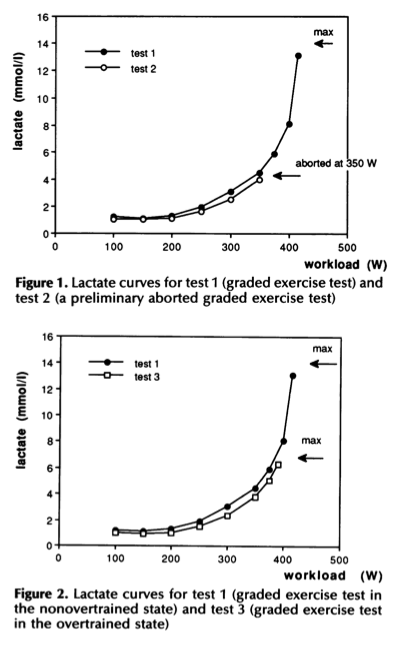
References
1 KuipersH,VerstappenFTJ,GeurtenP,VanKranenburgG. Variability of aerobic performance in the laboratory and its physiologicalcorrelates.IntJSportsMed 1985;6:197-201.
2 KuipersH,KeizerHA.Overtrainingineliteathletes:review and directions for the future. Sports Med 1988; 6: 79-92.
3 Morgan WP, Brown DR, Raglin JS, O’Conner PJ, Ellickson KA. Psychological monitoring of overtraining and staleness. BrJSportsMed 1987;21:107-14.
4 Barron GL, Noakes TD, Levy W, Smith C, Millar RP. Hypothalamic dysfunction in overtrained athletes. J Clin EndocrinMetabol1985;60:803-6.
5 DerevencoP.FloreaE,DerevencoV,AnghelJ,SimuS.Einige physiologische Aspecte des Uebertrainings. Sportartzt und Sportmedizin1967;18:151-61.
6 DressendorferRH,WadeCE,SchaffJH.Increasedmorning heart rate in runners: a valid sign of overtraining? Physician andSportsMedicine1985;13:77-86.
7 Kindermann W. Das Ubertraining: Ausdruck einer vegeta- tivenFehlsteuerung.DeutscheZeitschriftfirSportmedizin1986; H8: 138-45.
8 FosterC,SnyderAC,Thompson,NN,KuettelK Normaliza- tion of the blood lactate profile in athletes. Int J Sports Med 1988;9:198-200.
9 JacobsI.Bloodlactateimplicationsfortrainingandsports performance. Sports Med 1986; 3: 10-25.
10 JeukendrupAE,HesselinkMKC,SnyderAC,KuipersH, KeizerHA. Physiologicalchangesinmalecompetitivecyclists aftertwo weeks ofintensifiedtraining.IntISportsMed 1992; 13:534-41.
11 LehmannM.Sympatheticactivityinrelationtoperformance diagnostics,trainingandovertraining.IntJSportsMed1988;9: 390.
12 Brooks GA. Current concepts in lactate exchange. Med Sci SportsExerc1991;23:895-906.
13 LehmannM,BaumgartlP,WiesenackC,SeidelAetal. Training-overtraining: influence of a defined increase in training volume vs training intensity on performance, catecholamines and some metabolic parameters in experi- enced middle- and long-distance runners. Eur I Appi Physiol 1992; 64: 169-77.
240 BrJSpMed1994;28(4)
Cyclocross comes from the rich family of cycling disciplines. Road racing is the queen and has reigned over the sport of cycling from the beginning. Track racing, which can be traced back to the 19th century, “showcases a range of the most dynamic and extreme skills and tactics in the sport of cycling” according to the Union Cyclist International (UCI) definition of the sport. While mountain biking is relatively new compared to the other two, (only in its early twenties), this branch of cycling has gone through an explosive growth curve in the 1990’s, making it a very well known discipline.

Cyclocross, which predates mountain biking, did not receive the same enthusiastic reception. Seen mostly as a training discipline for road racing, it became an intense but fun way to work on fitness and handling skills during the off season. Known best in Europe, it was not until 1950 that the first World Cyclocross Championship event took place and not until recently that this discipline has attracted North American riders.

What is cyclocross? The classic picture would show a rider carrying a bike on one shoulder while climbing a steep and muddy hill. There is more to it.
In terms of technique, cyclocross is one of the most difficult forms of bike racing. The bike itself is very similar to a regular road bicycle with drop handlebars, regular size wheels and narrow tires. The course, however, has more similarity with mountain biking, using wooded trails and grassy or muddy steep hills instead of smooth pavement. Obstacles (barriers) that can’t be ridden are purposely placed on the course to force the riders to dismount and remount their bikes, adding a little running to this cycling event. Finally, the cyclocross season runs from early October to the beginning of February, making for usually cold racing conditions.

Still, cyclocross is different from mountain biking, as, contrarily to the fat tire sport, technical and mechanical support during the event is allowed and can become a major part of the strategy used to win a race. Since it is a winter sport, the mud can stick to the bike adding unnecessary weight, and creating mechanical problems. For this reason, a pit system, where trained mechanics provide riders with fresh, clean oiled bikes in exchange for their muddy ones has been developed over the years.

The sport is also spectator friendly. The track is designed on a short loop of approxi- mately two miles, usually looping back to the main area a couple of time. This allows everyone to keep track of the action and riders positions. The barriers, tight corners, steep muddy sections, and pit area are always good viewing spots. The course is short: riders come by often and when the pack is strung they come continuously. Races are also short, one hour for the top men’s category, making for intense racing from start to finish. There is no hiding in the pack and waiting for the final sprint.
Cyclocross, the perfect winter cycling activity.
The real beauty of cyclocross is that is it open to everyone from beginners to elite, junior to master. Each series offers races for kids, making the event a family outing. The races are short and fun and unless you are an elite racer, you don’t need a real cyclocross bike, any bike will do. Bring your mountain bike or your single speed; they have a category for you. All of the series organizers put on training sessions to demonstrate how to mount and dismount, carry the bike, jump barriers and much more. You can contact them directly to find out about these training opportunities. Cyclocross is a great way to extend your cycling season, to help maintain your level of fitness, and keep you cycling during the fall and early winter months. So go out there and discover for yourself what cyclocross has to offer.
Milosz Czuba1 , Zbigniew Waskiewicz2, Adam Zajac1, Stanislaw Poprzecki3, Jaroslaw Cholewa1 and Robert Roczniok4 , Zbigniew Waskiewicz2, Adam Zajac1, Stanislaw Poprzecki3, Jaroslaw Cholewa1 and Robert Roczniok4 |
|||
1Department of Sports Training, 2Department of Team Sport Games, 3Department of Biochemistry, and4Department of Statistics and Methodology, Jerzy Kukuczka Academy of Physical Education in Katowice, Poland
|
Simon A. Jobson1 , James Hopker1, Andrew Galbraith1, Damian A. Coleman2 and Alan M. Nevill3 , James Hopker1, Andrew Galbraith1, Damian A. Coleman2 and Alan M. Nevill3 |
|||
1Centre for Sports Studies, University of Kent, Kent, England, 2Department of Sport Science, Leisure and Tourism, Canterbury Christ Church University, Canterbury, Kent, England, 3Research Centre for Sport, Exercise and Performance, University of Wolverhampton, Walsall, West Midlands, England
|


 The Athlete Clinic