Chris Horner Stats for Stage 14 on the 2012 Tour de France
Average Power: 209 watts, Average Speed: 36kph, Energy Used: 4026kilocals, Altitude Gain: 2605m, Time Riding 5:20


Chris Horner Stats for Stage 14 on the 2012 Tour de France
Average Power: 209 watts, Average Speed: 36kph, Energy Used: 4026kilocals, Altitude Gain: 2605m, Time Riding 5:20
Ag2r-La Mondiale rider Jean-Christophe Peraud’s power profile which earned him second place on stage 12 after a long day (5hr 42mins) in the saddle. Average Power: 240w, Average Cadence: 91rpm, Energy burned: 5000 kilocals and an Average Heart Rate: 133bpm
 (Click on Image to improve quality)
Images courtesy of SRM
Vincenzo Nibali on the Col de Madeleine: Average Power 322 watts for 60mins
Click on image to improve Quality
 Col de le Croix Fer: Average 333 watts for 60mins
 Final climb of the day up to La Toussuire: Average Power 358 Watts for 50mins
 Stage 11 Profile

Average Power: 188watts, Average Speed: 42kph, Energy Used: 3500kilocals, Time on Bike: 5:15: Altitude Climbed: 1540m
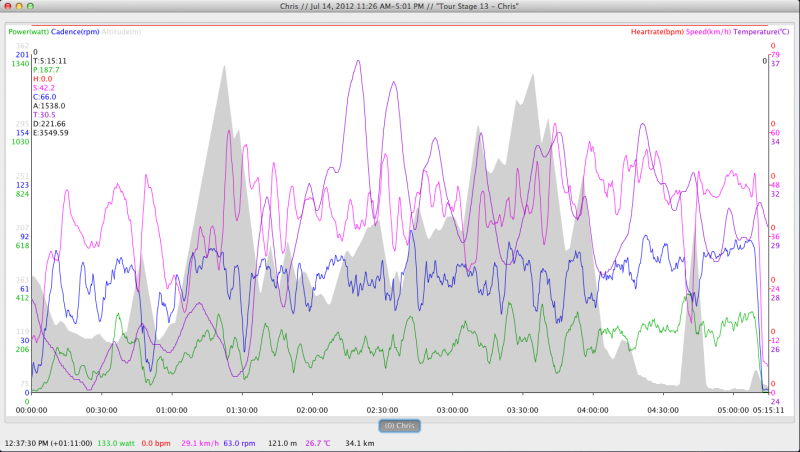
Chris Horner’s power profile from todays Stage 11
The first 2hrs were done at an average of 282 watts with the average power for the stage being 264, speed was 30kph with 5hrs 10min in the saddle and he said that he is finding it quite hard to walk this evening. I’m not surprised with a total elevation of nearly 4720m and just short of 5000k/cals burned.

Line-outs – Echelons and Scrubbing
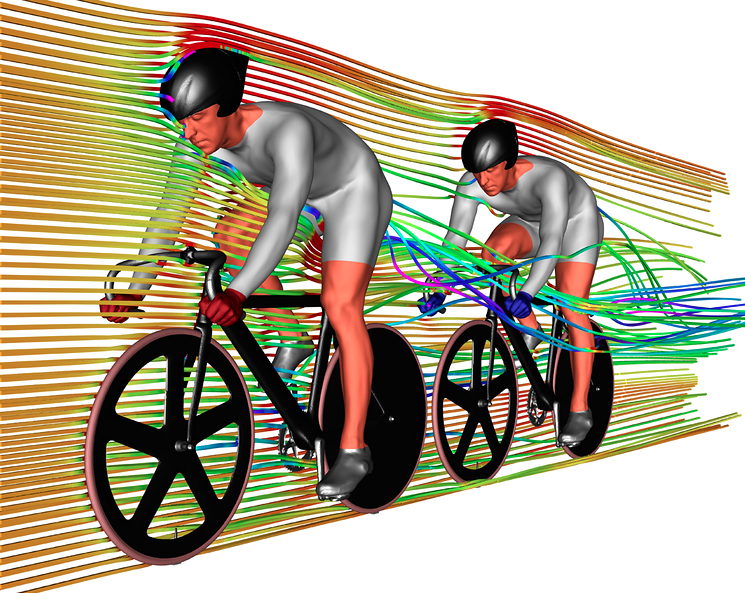
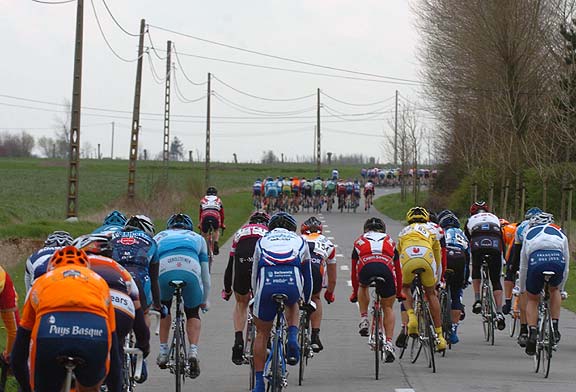
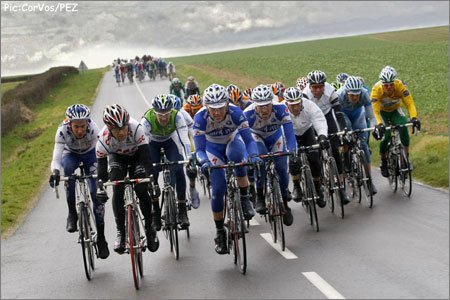
The first ride in the image below is overcoming a total resistance on his frontal area. The frontal area being the area of his body that he is exposing to the direction in which he is traveling. We can see from the smoke trails that he is overcoming resistance and in doing so he alters the smoke trails and sets a new pattern of smoke trails for the rider behind him. The new trails behind offer to the rider behind have are considerably less in number to the front rider. If we put a weight value of 1kg to each of these trails we can see how the rider in front would be carrying considerably more kilos than the rider behind and experience fatigue much quicker that the rider behind. Riding correctly in another riders slipstream wether it be a headwind, tailwind or a crosswind can save up to 30% of your power and give you the edge needed for the win. If the wind is coming from the left the rider needs to be on the right of the rider in front and depending on how much of a crosswind will depend on how far up along the ride the second order needs to be. Vice versa for the right crosswind and exactly behind for the headwind. The rider in front can also use the crosswind to shed riders from his wheel. If the a crosswind is coming from the right then the rider in front can put himself and his bike on the left side of the road as close to the gutter\kerb as possible. This will prevent the riders behind getting and shelter and put those sitting in under pressure. So when your in a line-out or in an echelon this is the reason why.

General book Information
The author of this book is Shannon Sovndal. Sovndal is an MD attending medical school in Columbia University in New York and completing his redidency at Stanford University in California. He is owner and co-founder of Thrive Health and Fitness Medicine. He has also served as the team physician for the Gramin/Chipotle pro-tour team and is currently working as a board certified emergency medicine physician at Boulder Community Hospital in Colorado. He also has district medals for road racing in California and Nevada Championships.
The book can be bought on line for around the 20 euro mark either in eBook form or the traditional paperback.
eBook: http://www.humankinetics.com/products/all-products/cycling-anatomy-ebook—pdf
Paperback: http://www.humankinetics.com/products/all-products/cycling-anatomy

Review
The book is Forwarded by Christian Vande Velde (CVV). In his forward he explains how he and Sovndal have been friends for many years and also explains how Sovndal guided him through the weights room and prescribed exercises in order to eleviate pain and discomfort that Vande Velde had been experiencing on the bike over many years. Due to Sovndal’s assistance and guidence CVV is of the opinion that now he is a big advocate of gym work in order to balance the body both in the off season and during the racing season.
The book is laid out in nine chapters:
1. The Cyclist in motion
2. Arms
3. Shoulders and Neck
4. Chest
5. Back
6. Abdomen,
7. Legs (Muscle Isolation)
8. Legs (Complete Power)
9. Whole Body Training for Cycling.
Chapter 1 gives a brief but conscience description of the muscles used during cycling and of the function of cycling. Muscle makeup and muscle physiology is described in order to give the athlete an understanding of how the muscle works both under pressure and at rest. Cycling position is also discussed which direction given to correct posture and position on the bike. Important muscle groups are outline and their actions described with reference to the athletes position on the bike and also to their actions during the biomechanical movements.
Strength Training Principles and Recommendations are discussed including mimicking the cycling position while exercising, whole body workouts and how to vary the program. Different types of weight Training workouts are also outlined i.e. low weights-high reps, high weights-low reps, circuit training, pyramid sets and supersets
For chapters 2 -9 the book provides first a brief description of the muscles used in cycling and shows each muscle in a picture format and how it;s stressed during the cycling motion. So if your a sprinter and you want to strengthen your upper body because you may feel a weakness then go to chapter 2 Arms and have a read. It will describe the muscles used and how to train them in a step by step description accompanied by pictures and diagrams. The same can be said for masters wanting to maintain strength. Chapter 9 Whole Body Training for Cycling can be used or just chapters 8 & 9 if the masters rider believes their legs are the only limiter.
This book again is good for the athlete who self prescribes and is interested in adding a new dimension the his/her training regime. I would also recommend the book to those of you starting on your first winter of weights activity as this should and will prepare you well once you read it all. I have previously described weight training on the bike and these two programs could be combine in order to eliminated or seriously improve an athletes limiter.
http://sportsexerciseengineering.com/2012/07/10/professional-cyclists-bike-strength-training/


Jens Voigt (click on file to improve quality)
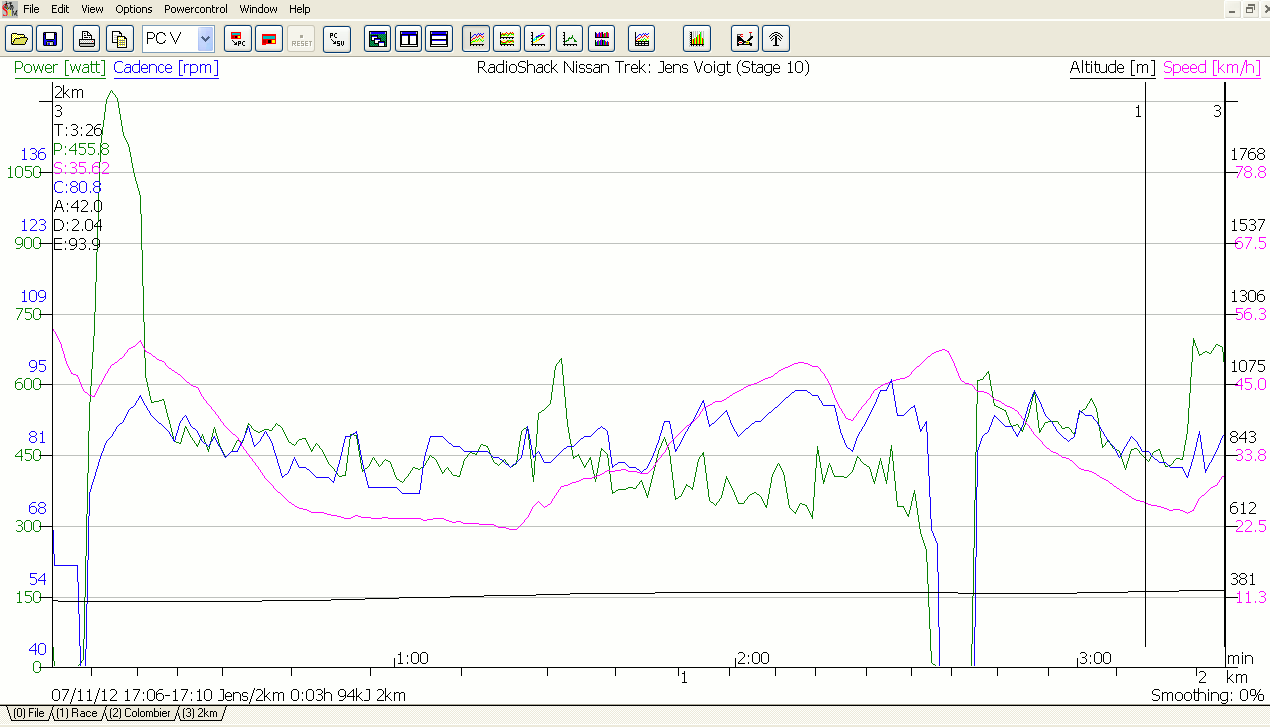
 Jens Voigt had an average power of 319 watts for nearly 4hrs 50 mins during stage 10. The average speed for the day was 40.5kph. The black line shows the profile of the route with some severe climbing on the stage. Total altitude for the day was nearly 2900 meters and Jens burned 5,300 k/cals

The above file is a selection from the stage. It is the Col du Grand Colombier climb. His average power for the climb was 400 watts and below we have hid final 2km of the stage where Jens managed to average 456 watts with final sprint into the line of 1225 watts.
Daryl Impey (Orica Green Edge) Stage 2 power file
4:56:59, 207.5 km, 221 TSS, 068 IF, 283 NP, 201 avg watts, max watts 1284 
Strength Training on the Bike
Over the years there has been numerous discussion regarding strength training for the cyclist. Some advise the weights room, some advise plyometrics and some advise on the bike strength training. Today I’m going to outline the method for strength training on the bike.
Slow Revolution Repititons or S2R’s as used by SportsExerciseEngineering.com (SEEng.com) is an on the bike strength training regime. Similar type systems have been used in the past by Dr. Aldo Sassi and Dr. Massimo Testa. The system is aerobic by nature and improves circulation in the muscles which would normally be impaired during muscle contraction. Contracting the whole of the muscles used in the full pedaling stroke increases its efficiency with reference to circulation thus increasing aerobic levels.
Before doing any strength training on the bike it is very important that a rider be 150% sure that there is no potential for injury as this type of training can be very severe on the knees, ankles and hips.
Cadence on the strength will tend to get as low as 35rpm. For riders with potential injury issue higher(60 – 70rpm) cadences can be used with reductions coming as the body accustom itself to the loads being applied. Cadence in the norm should vary between 35-45rpm.
The intensity levels of the workout should be around 80-90% of your Threshold Heart Rate (THR) and 84-94% of your Functional Threshold Power (FTP).
These workouts should be completed on grades of between 3-6% or on a flat road into a head wind in order to create the resistance needed. It is important to ensure that training Zones and RPM (Gearing) are correct in order to elicit the required effects on the body.
During these workout it is worth considering other issues like pedaling technique, pushing and pulling through the whole stroke especially over the top, also body position on the bike i.e. no rocking from side to side and try to stay seat and relaxed in the saddle.
Sessions should be short at first with durations building as adaption occur i.e:
4 x 1min on + 2min off, 6 x 1min on + 2min off, 8 x 1min on + 2min off improving to
4 x 5min on + 10min off, 6 x 5min on + 10min off, 8 x 5min on + 10min off.
The rider needs to be patient with these as they take time to develop the muscles but you will see more for them.


 The Athlete Clinic