2014/15 Goals and Beyond.

“Fail to Plan, Plan to Fail”

We here this old saying every year. How many of you plan everything out to the last. The plan is so extensive and detailed it becomes no fun, it dictates life, it starts to annoy you, you become tired, loose motivation and eventually the plan goes in the bin.

Sound familiar?

At Sports & exercise Engineering we take all that planning out of your goals and manage you and your training in an effective and efficient manor. We use the latest of technology that is available today. We apply the highest standards used in the coaching world today. We get you to your peak. Remember “A Goal is only a wish until you have a Plan” All our plans are specific, progressive and applicable to the athlete or individual in question. Generic is not a term we are familiar with.

Fitness Testing in our clinic in Galway. From Step Tests to VO2/Lactate Testing

wpid-20131213_110258.jpg

Wether your a high performance athlete or someone looking to get fit and back into the groove why not give us a call to discuss your options for 2014. Contact form is HERE or you can call in using the directions HERE

Posted in Training | Leave a comment

Hypoxic Training Improves TT Performance and Power Output

The Athlete Clinic's avatarThe Athlete Clinic

Elite cyclists endurance performance following Intermittent Hypoxic Training (IHT)

THE EFFECTS OF INTERMITTENT HYPOXIC TRAINING ON AEROBIC CAPACITY AND ENDURANCE PERFORMANCE IN CYCLISTS

We welcome your opinion on all the papers we post. Add your comments, thoughts or your own articles below.

Summary of the paper:

Well controlled and applied endurance sport research. 20 male elite cyclists randomly divided into a hypoxic or normoxic group trained at 95% (hypoxic) or 100% (normoxic) of individual lactate threshold, 3 times a week for 3 weeks. After a rest week the hypoxic group managed a significantly improved 30km time trial with a 5.6% increased in average power and 2.6% improvement in time trial performance. The normoxic group did not see any significant differences post training.

The study highlights that haematological adaptations may not occur when only using IHT. However when combined with an adequate training stimulus muscular adaptation (increase mitochondrial density, cappilary length…

View original post 213 more words

Posted in Uncategorized | Leave a comment

Athlete Testing at The Athlete Clinic

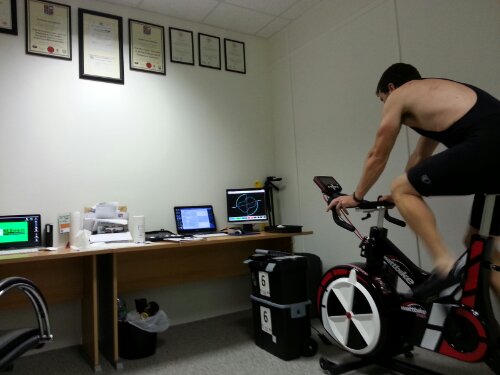
A rider being put through his paces in our testing suite today.
image

Pedal Stroke Analysis and Lactate profiling to Power & Heart Rate has allowed this ride to produce the same power output at a lower input aas he was doing during his peak racing time this year without any work over Zone 3.
image

Measurable outcomes are the only way to improve and be sure your work is correct.

Posted in Uncategorized | Leave a comment

Ramp Testing (LT + Hr + Pwr), Pedal Stroke Efficiency Analysis & Body Fat Analysis

Measuring your Improvements

What is a “Measurable outcome” pertaining to Athletes? It is when you pre-measure a parameter be it Lactate Levels at a particular Power Output or Heart Rate or Pace. Then you complete a training prescription and post-measure again. The difference between the pre-measure and the post-measure is your measurable outcome. The measuring needs to be consistent and mirrored as to not have an effect on the results for comparison.

Screen Shot 2013-12-04 at 16.55.43


At Sports & Exercise Engineering we bring these measurable outcome practices to the athlete be the athlete an Elite or Beginner. We standardize and regulate our testing so as to eliminate influenced results. This ensures a true and transparent result from testing and a true value of your positive or negative outcome. Once you have your results you can evaluate the effectiveness of your Training Prescription. We in house can advise on your prescription or one can discuss with your own coach.


Sports & Exercise Engineering use the most up to date tools and practices to measure that athletes can avail of a standardize protocol with accurate results each and every time.

Screen Shot 2013-12-04 at 17.06.54


We can’t emphasis enough that the results obtained from training in your correctly tested zones, your improved pedal stroke efficiency from analysis and technique correction along with weight reduction in a correct manor can bring to your results.

You can contact us Here for an appointment or even to discuss your options regarding  what our Team can do to improve your performance. Our Clinic is based just 2mins from the Galway end of the M6.

Posted in Uncategorized | Leave a comment

Janos Köhler tells us his side…Down Hill Road Rage World #1, coached by us here at SEEng.ie

Check out the video which contains some great realtime footage and interviews https://www.youtube.com/watch?v=OtOyQ5kjDzY Janos

Posted in Uncategorized | Leave a comment

Automated Bike Fit Measurement App Review: Bike Fast Fit

Probably one of the coolest apps out there at the minute, I haven’t reviewed it yet but DC Rainmaker generally do a good job and from what iv’e seen here it could be a fun tool.
Check it out here at DC Rainmaker

IMG_3120_thumb

IMG_4617_thumb

IMG_3133_thumb

Posted in Uncategorized | 1 Comment

How to Start Your Winter Training

Beginning your winter program.

 There is no time like the present for setting out ones stall for the 2017 competitive season whether you’re a cyclist, swimmer, runner or triathlete. It’s vitally important each and every year to rest the base for which you intend to perform on. What base is that you ask? Well it’s the base that you will aim to achieve your goals for 2017 on and beyond. Lets take a look at a few things you might need to do in order to have this base in perfect shape.

 Balance Work & Coordination

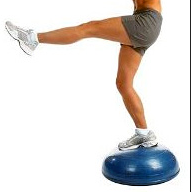
How many of you have ever completed a balance & coordination session, I bet there are so many of you out there that can’t even skip. Riding a bike and running require various coordination skills. If these skills are poor then you can be guaranteed that your efficiency as an athlete will be reduced. This can be measured by your input to output ratios. If your putting in a immense amount of effort and not going very fast you can be sure that this area of your ability is where some of you problems lie. Balance & coordination exercises can be classified with drills like “one legged balancing & skipping”.

Screen Shot 2013-10-10 at 15.29.50

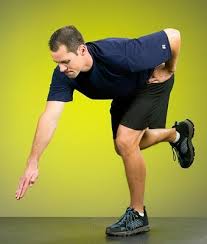
Proprioceptive Sessions

Proprioception means “sense of self”. In the limbs, the proprioceptors are sensors that provide information about joint angle, muscle length, and muscle tension, which is integrated to give information about the position of the limb in space. One particular issue I see with cyclists is there leg extension control in isolation without support. With lack of control at the top and bottom of the pedal stroke indicating a poor muscle firing pattern and reduction of power/force through the leg into the pedal. With correct exercises the proprioceptors can be trained and this will provide fare superior control to the athlete during functional movement while training and competing. Again as in the balance & coordination this will improve the athletes input to output ratios. Exercises typical to proprioceptive improvements include the use of wobble boards and Swiss/exercise balls. A number of balance & coordination exercises will also double as proprioceptor workouts.
images

Plyometric Workout’s.

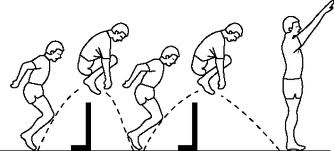
These workouts are great for building strength and explosiveness in an athlete. They are generally completed using one’s self-weight. Although I have seen some elite athletes holding medicine balls when they have become exceptionally advanced in their sessions. Simple exercises include jumping from the floor with both legs onto a box approx. 18 inches high. The box height will vary depending on athlete. Forward one-legged hops, lateral one-legged hops are also classed as plyometric. It should be noted that these exercises can be quite demanding and should be started at the low intensity level with care taken on the knees and ankles. As the athlete improves the workouts can progress to moderate and then more advanced.
 images-1

Putting it all together

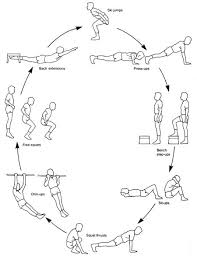
Circuit training is a mix of the above and also a few other types of exercising. For a circuit training session to be beneficial to the athlete it needs to be specific to the athlete’s needs and applicable to his/her sport. No point in doing a rugby designed circuit training program if you’re a swimmer. Circuit training routines allow the athlete or coach to create an endless number of workouts and add variety to routine. A good routine will alternate from lower to upper body from plyometric, to isometrics exercises and from balance, coordination to proprioceptive specific tasks. This allows for the intensity to be maintained while providing recovery and maximizing training intensity. Specific routines can also be developed to correct the muscle imbalances that often occur in one-sport athletes who specialize in one type of exercise day after day. Circuit training is ideal for both advanced athletes and beginners because it can be scaled to the ability of the athlete. But again these routines need to be designed correctly or little benefit or even imbalances and injury will occur.

Designing your own Routine

Typically a routine will have 10 to 12 exercises or stations as they are called. Each station will be specific and will have a duration of typically 60 seconds. Rest periods between stations will depend on athlete fitness and competence, ranging from 15 to 30 seconds. The circuit of stations will be completed 3 to 5 times again this number is dependent on ability.

 Guidelines

  • Include 10-12 exercise for your sport or requirements
  • Exercise for 60 sec
  • Complete 3 – 5 circuits
  • Do routine 2 – 4 times per week
  • Make sure bands, medicine balls etc. are correct resistance and weight for you
  • As you become more efficient increase resistance or level or exercise.
  • Have a stopwatch

Unknown

Our advice is to have an appropriate and personal circuit training routine developed for you or your group that targets the sport you compete in. This will develop a strong and powerful base for setting your training on for the 2017 season. It will also correct imbalances and improve weaknesses that can lead to injury during your competitive phase. For more information you can contact us at theathleteclinic@gmail.com.

Posted in Reviews | Leave a comment

Health and doping in elite-level cycling.

An abstract from a paper released last year which looked into the attitudes of professional cyclists from new to retired.

Abstract

The protection of the health of athletes is one of the three criteria taken into account when registering a substance in the World Anti-Doping Agency prohibited list. Nevertheless, in elite-level cycling, banned substance use is widespread. The present research adopted a psychological approach to examine how or whether perceived health risks influence elite-level cyclists’ decisions to use banned substances. Sixteen semi-structured interviews were conducted with cyclists hoping to join a professional team (n=6), neo-professional cyclists (n=2), and former professional cyclists (n=8). Although an evolution was observed in the organization of doping and perceptions of doping over the last decade, the perceived health hazards did not influence, most of the time, decisions to use banned substances among the sample of cyclists. There was a systematization of exogenous substance use in the cycling environment and a trivialization of the side effects of the banned substances. Finally, younger cyclists were not concerned about the long-term health consequences of banned substances; they were more focused on the short-term performance-enhancing benefits. There is a need to implement more effective preventive programs to change athletes’ attitudes toward doping and its health risks.

Posted in Reviews | Leave a comment

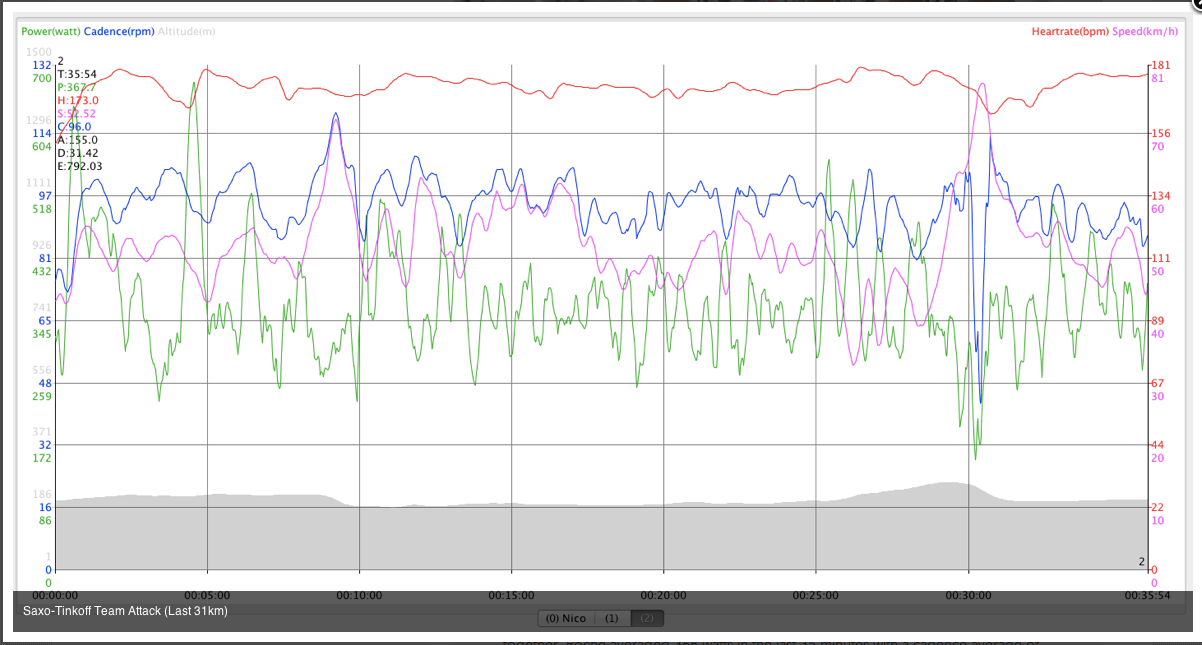
Nicolas Roches’s SRM File for the 31km Team Saxo attack in TDF

This is the SRM file from Nicolas Roches’s effort when Team Saxo attacked with 31km to go on stage 13 of the 2013 Tour de France.

Screen Shot 2013-07-13 at 10.02.25

Posted in Reviews | Leave a comment

3 min all-out test predicts 16km Road TT Performance

Critical power derived from a 3-min all-out test predicts 16.1-km road time-trial performance.

Source

a Sport and Health Sciences, College of Life and Environmental Sciences , University of Exeter , Exeter , UK.

Abstract

Abstract It has been shown that the critical power (CP) in cycling estimated using a novel 3-min all-out protocol is reliable and closely matches the CP derived from conventional procedures. The purpose of this study was to assess the predictive validity of the all-out test CP estimate. We hypothesised that the all-out test CP would be significantly correlated with 16.1-km road time-trial (TT) performance and more strongly correlated with performance than the gas exchange threshold (GET), respiratory compensation point (RCP) and [Formula: see text]O2 max. Ten club-level malecyclists (mean±SD: age 33.8±8.2 y, body mass 73.8±4.3 kg, [Formula: see text]O2 max 60±4 ml·kg-1·min-1) performed a 10-mile road TT, a ramp incremental test to exhaustion, and two 3-min all-out tests, the first of which served as familiarisation. The 16.1-km TT performance (27.1±1.2 min) was significantly correlated with the CP (309±34 W; r=-0.83, P<0.01) and total work done during the all-out test (70.9±6.5 kJ; r=-0.86, P<0.01), the ramp incremental test peak power (433±30 W; r=-0.75, P<0.05) and the RCP (315±29 W; r=-0.68, P<0.05), but not with GET (151±32 W; r=-0.21) or the [Formula: see text]O2 max (4.41±0.25 L·min-1; r=-0.60). These data provide evidence for the predictive validity and practical performance relevance of the 3-min all-out test. The 3-min all-out test CP may represent a useful addition to the battery of tests employed by applied sport physiologists or coaches to track fitness and predict performance in atheletes.

Url Link: Here

Screen Shot 2013-07-02 at 10.40.12

Posted in Reviews | Tagged , | Leave a comment